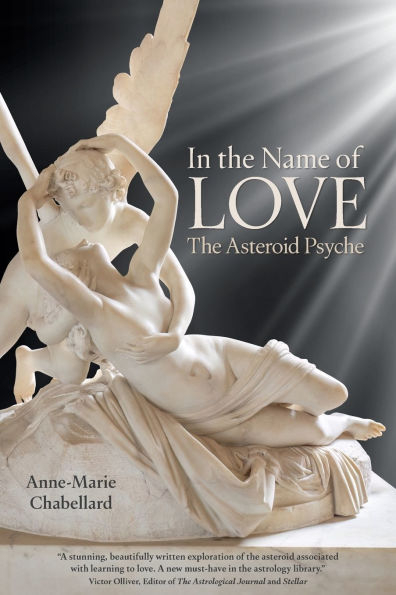
Toward the beginning of her inspiring new book, author Anne-Marie Chabellard notes that for astrologers, the relevance of asteroids has achieved far from “unanimous support.” We haven’t yet thoroughly studied the asteroids, and there is as yet no consensus for how to interpret them.
That said, In the Name of Love is an exemplary work, perhaps the first in-depth study and interpretation of Psyche, one of the largest of the asteroids, discovered in 1852. Psyche has a five-year cycle around the Sun and spends between two and ten months in a sign.
Anne-Marie Chabellard is a research and consulting astrologer based in Paris. She holds a Ph.D. in biological sciences, a degree in psychology, and she has studied astrology, mostly with a Jungian approach, for over twenty years. Her work on the asteroids is rooted in her study of myth as well as in her client work.
With In the Name of Love, Chabellard convincingly makes asteroid Psyche relevant by situating her interpretations of this asteroid within mainstays of psychological astrology. She writes that there are “three keys” to interpreting Psyche in astrology: Venus, the Sun, and “the notion of inner qualities whose revelation is necessary to serve them.”
Crucial here is the element of choice. “The discovery of Psyche marks a turning point in the collective vision of what Venus represents,” she writes. “Venus implies choice,” and up to the mid-19th century period of the Romantic movement—around the time of asteroid Psyche’s discovery-- people chose work and romantic partners, but they usually didn’t choose their spouses.
The myth of Psyche predates even its earliest written rendition which was a second century novel, The Golden Ass, authored by Platonic philosopher Lucius Apuleius. In the myth, Venus has become offended by one of the daughters of a king, Psyche, whose beauty is mortal and fleeting, whereas Venus’ beauty is divine. Psyche has fallen in love with Venus’ son Cupid (the Roman name for the Greek god Eros) despite Psyche’s not knowing Cupid’s true identity as a god. One night, Psyche lights an oil lamp to see who her beloved really is. By accident, a drop of hot oil burns Cupid, and he flees, leaving Psyche with the “loss and longing” that, Chabellard writes, “are at the heart of the astrological interpretation of the asteroid Psyche.”
Venus punishes Psyche by demanding of her four “labors.” Psyche is made to: sort a pile of seeds; retrieve for Venus some wool from a sheep’s golden fleece; fill a vessel with water from a dangerous source; and descend down to Hades to bring back a box of Persephone’s beauty. These labors correlate with four Platonic virtues and also four requisites for a healthy, happy relationship: wisdom, moderation, courage and justice.
When Psyche completes these labors--and has developed these virtues--she becomes immortal. Jupiter approves the marriage of Psyche and Cupid, and Venus finds herself satisfied. Meaningfully, Chabellard posits that Psyche “is a component of our chart that urges us to love and admire in another what belongs to us, but to which we can only gain access after certain stages of development, our ‘labours,’ have been completed.”
Part of Chabellard’s thesis is that “no interpretation of Psyche can be made without first looking at Venus’s position in sign and house and her aspects, for Psyche gained immortality and divine beauty at the same time as Venus was again satisfied.”
In the Name of Love is a complex book. It’s not what astrologers call a “cookbook.” There are only a few pages with a paragraph each for natal Psyche through the twelve signs, well worth reading. Mostly, this book treats Psyche as a relationship asteroid, in relationship to astrological Venus and the Sun, particularly in the astrological chart as it moves through time, by the symbolic technique of progressions.
Chabellard quotes the late Jungian astrologer Howard Sasportas, who wrote of “the progressed Sun as a torch which shines on whatever it is touching.” Chabellard takes this to heart. She studies how, as the progressed Sun makes aspects to natal Psyche over the course of a lifetime, “meaningful events linked to relationships happen.” Such is the case, whether the aspect is a conjunction, opposition, square, trine or a “minor” aspect such as a sextile, quincunx or semi-sextile. Chabellard uses narrow orbs of half a degree before and after an exact aspect, or about six months before and after relevant events-- though the consequences of any event can last much longer. The progressed Sun’s “encounter with Psyche is a time when the way we honor Venus needs to be questioned.”
In the Name of Love includes twelve chart studies of progressed Sun/Psyche “encounters.” Psyche is activated by transits and progressions, “if Eros has already brought us into contact with someone we love” including in both romance and deep friendship.
The French existentialist writer Simone de Beauvoir met the love of her life Jean-Paul Sartre when her progressed Sun had just entered a half a degree of orb square to her natal Psyche. Throughout a year, she at first began “forgetting herself in love for Sarte, but later, “the qualities of her Psyche in Scorpio were revealed, allowing her to exercise the lucidity so dear to this sign of deep emotional insight.”
The chart of John Lennon emphasizes the importance of relationship as his natal Psyche is in an exact trine with his Venus-ruled Libra Sun. When Lennon’s progressed Sun, then in Scorpio, made an exact quincunx to Psyche in November 1970, he was in the throes of a year of breaking up with the Beatles. He was also beginning work with Primal Scream therapy, and working on his first solo album, John Lennon/ Plastic Ono Band. Lennon was having major Venus transits at the time, too, with transiting Uranus conjunct progressed Venus and transiting Chiron square to progressed Venus.
With one example after another, (including charts of Nietsche, Isaac Newton, Marie-Antoinette, Marcel Prouset, Robert F. Kennedy, and others,) Chabellard shows how “the activation of the asteroid Psyche enables us to develop inner qualities, which have not yet reached consciousness, necessary for the healthy and complete expression of the planet Venus.”
What’s so exquisite about this book is two-fold. Chabellard shows how very relevant the asteroid Psyche is to astrology; and she does so, like the myth for which Psyche is named, by the light of and as a tribute to Venus, who “possesses both the gift of connecting us to ourselves, and to the divine.”
~review by: Sara R. Diamond
Author: Anne-Marie Chabellard
Wessex Astrologer, 2026
184 pp.