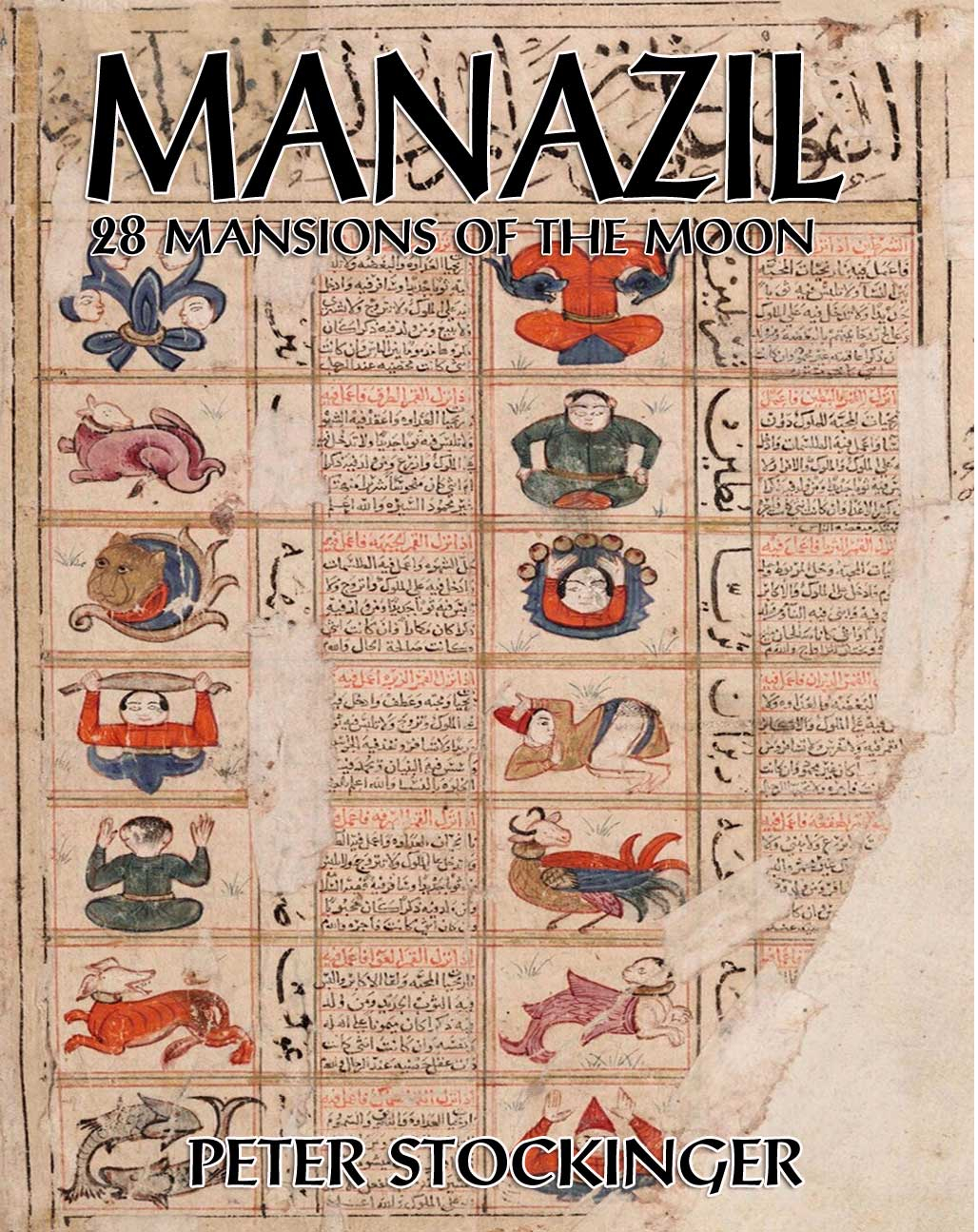
Books on lunar mansions aren’t abundant when looking for options outside of Hindu astrological literature. Lunar mansions are crucial for natal analysis and forecasting in Hindu methodology, but are far less used in Western astrology. The Hindu nakshatras aren’t the only version of lunar mansions, and there are separate cultural versions used by medieval Arabic-Persians astrologers and by the Chinese. The Persian manazil (mansions) are distinct from the Hindu version with different stellar asterisms and meanings. The Arabic-Persian manazil were carried to Europe in the late 10th century CE.
Stockinger has collated available literature from the medieval Arabic-Persian culture and presents it in this book. Some of the material included here is translated into English for the first time. The book’s Introduction is valuable as a stand-alone essay as it traces the history of lunar mansions. The author shares unusual divinatory methods linked to the use of mansions in Europe, which were developed over the course of several centuries. Mansions weren’t only used for birth forecasts but also for elections and the creation of talismans. Lunar mansions are included in one chapter of Picatrix, or Ghayat al-Hakim (The Goal of the Wise), a book about astrological talisman construction written in the first half of the 11th century. Another use of lunar mansions is weather forecasting. There are brief biographies of significant medieval and Renaissance Arabic and European astrological authors who contributed to literature on lunar mansions. The Introduction ends with tables of the names of the lunar mansions in Arabic, Latin, German, and from the 1651 translation into English by John French.
Part II presents information about the 28 mansions compiled from available sources. It identifies the main star or stars in the mansion’s asterism and quotes remarks from significant authors. The boundaries of mansion are given for the current longitudinal position of the stars. Meanings for each mansion are provided from multiple authors including Abenragel, Al-Biruni, Picatrix, Ibn al-Hatim, Ibn Arabi, Bonatti, Jafar, and Brenner. There are also descriptions of the face images from multiple authors, as these vary greatly depending on the sources. Part II is a significant section of the text, from page 37 to page 148.
Part III provides a detailed overview of the source material. Translations are given in entirety. End matter includes a bibliography and index.
Manazil is a unique book on a historic topic. As these primary resources are extremely obscure and aren’t available elsewhere, Stockinger’s book is particularly valuable for people working in astrological magic as well as astrologers who utilize medieval Persian and European astrological methods for natal chart analysis, elections, horary, and forecasting. Highly recommended.
~review by Elizabeth Hazel
Author: Peter Stockinger
BM Mandrake, 2025
288 pages.
(Note – Kepler College Book Club Q&A interview of Peter Stockinger for this book, YouTube link: https://www.youtube.com/watch?v=mb2bMMmhsY8 )