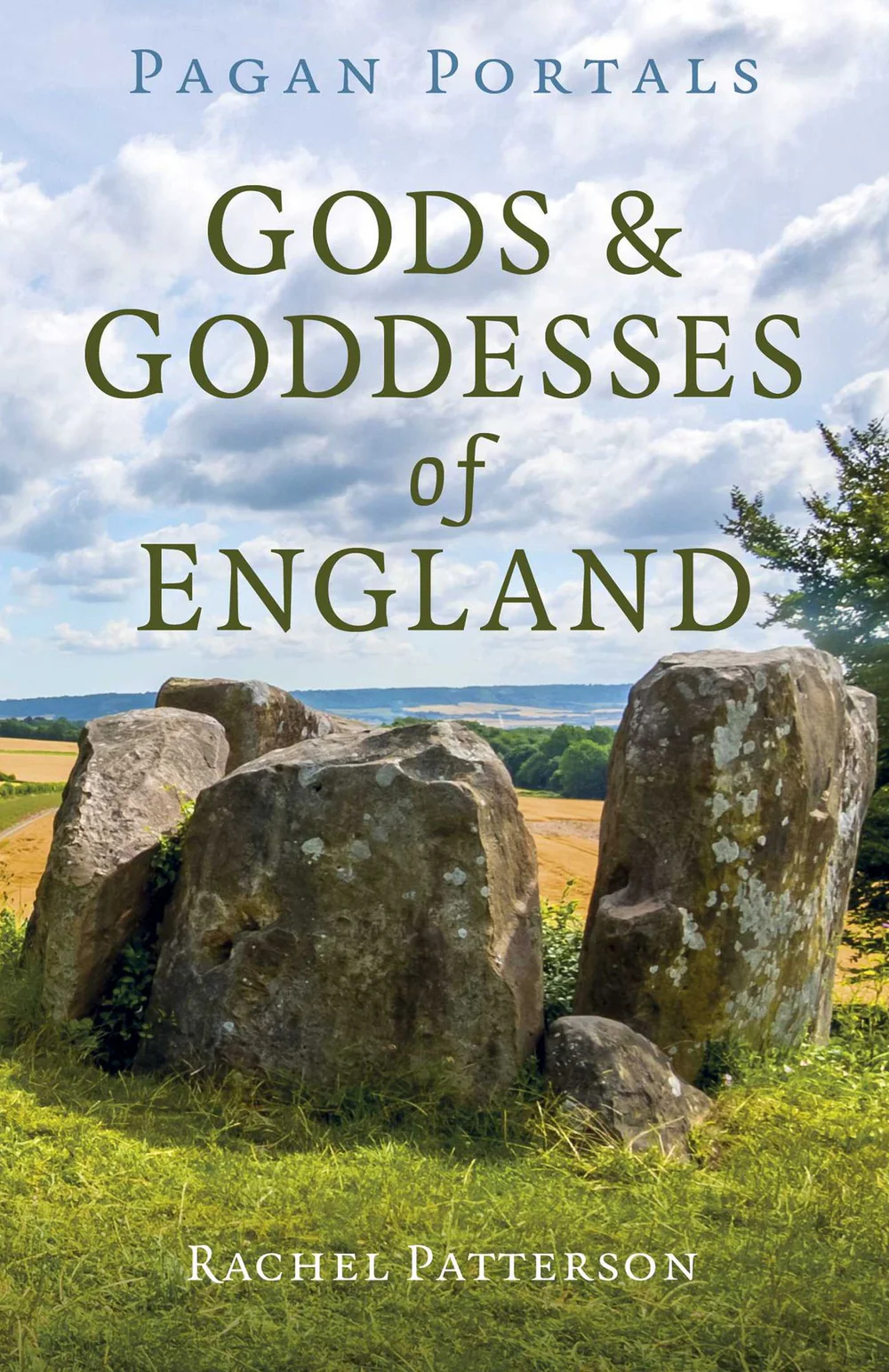
If the history of a nation can be illuminated at least in part by a study of its divinities, then Rachel Patterson’s Gods & Goddesses of England, part of the Pagan Portals series, can cast light on Britain’s complex past. The book opens with an overview and timeline that contextualizes the history of England and the larger British Isles from the earliest evidence of human habitation going back to the Palaeolithic, ca. 700,000 BCE and carrying through the Mesolithic and Neolithic (ca. 9,000 BCE to ca. 2,300 BCE), on through Iron Age Britain (ca. 650 BCE to ca. 550 BCE), and thence through the Roman occupation of Britain (55 BCE to ca. 550 CE), and finally through the Dark Ages and Viking Age (ca. 560 CE to ca. 980 CE) and up to the Norman period with the 1066 Battle of Hastings and the crowning of William I, Duke of Normandy and King of England. It is a detailed timeline but an understandably abbreviated one, to cover such a tremendous span of time. Patterson’s purpose is to show the vast age of Britain’s human habitation and the diversity of its demographic makeup, which even from the Iron Age on comprised a huge number of tribal groups from Picts and Saxons and Norsemen and Celts and numerous other archaeological tribes such as the Beaker Culture.
Patterson includes a listing with brief descriptions for a total of 38 tribes who inhabited the British Isles at one point or another (the list is not comprehensive). Examples of those tribal names, some of which may sound familiar and others entirely alien, include the Cornovii, Lugi, Vacomagi, Caledonii, Selgovae, Brigantes, Parisi, Silures, Belgae, and Iceni (famed for the fierce warrior-queen Boudicca). And of course there were also the Romans and the Vikings, and that in itself is simplifying things. And each of those tribes left evidence of their existence and at least some concept of their divinities in votive inscriptions, coins, figures, temples, shrines, and other artifacts in the archaeological record. Some written evidence exists. But most of what can ever be known of the worship practices and divinities of the deep English past will remain a matter of speculation and constructive imagination. Nevertheless, the evidence that does exist in the archaeological record, as Patterson summarizes, does point to not only an ethnically diverse but a spiritually diverse melting pot every bit as complex as any in the modern age.
That diversity is further manifest in the pantheon of Britannia that Patterson features in part two of Gods & Goddesses of England. It is in fact the bulk of the book, at 63 pages that contain 68 entries of Celtic, Saxon, Germanic, Romano, and other syncretic or “blended” gods and goddesses. The pantheon in Britain is in fact a pantheon of pantheons, and it gets rather complicated. As Patterson writes, “It becomes tricky because we had so many outside influences creating mini pantheons within pantheons such as Romano-Celtic, Saxon-Germanic and Norse-Germanic. And, of course, we are back to the lack of anything written down to support them. Somewhere along the way, the English pantheon got lost and in a lot of cases was assimilated into the Romano-Celtic grouping” (Patterson 31).
Within those 68 entries of Britain’s diverse “pantheons within pantheons” the reader will find some deities which may be familiar, such as Brigantia and Britannia, Eostra/Eostre, Epona, Hreda, Matres/Mothers, Nerthus and Nodens, Sabrina of the River Severn, Seaxneat/Saxnôt, Sulis, and Weland/Weyland/Wayland the smith god whose story can be read in the Völundarkvida, a 13th century Icelandic Edda. The remaining 52 entries I suspect will be new information. Patterson presents these entries in a kind of short, encyclopedic format in which the deities are named and the localities associated with them listed as well as inscriptions, coins, figures, and other artifacts in which the deities are named or in which the archaeological evidence otherwise supports their worship. Most entries are short, some are very short, and others about which more is known run through an entire page or more. The names themselves are fascinating, and one can glean much about the history of Britain and the diversity of worship in ancient Britannia from all of the entries in the book.
In the final section, Patterson highlights three divinities as illustration of how the reader might go about in fostering a stronger personal connection with them: it focuses first on Belisama, then on the Three Mothers/Matres, and finally rounds out with Sabrina. This last section is fairly short, at 17 pages, though Patterson provides a wealth of information about each of the deities, including more details on their histories and mythic origins as well as landscapes and locales associated with them, alternative names and spellings, elemental correspondences, what kinds of attributes and blessings one might call upon the deities for, and Patterson also sketches rituals and meditations for calling upon their power. Another fine touch in each of these final portraits is a recipe in each for cakes and treats one can make as very practical magic to honor and celebrate these divinities. Rachel is not only a practicing pagan but a self-proclaimed “kitchen witch.” I now understand a bit more, I suppose, of what she means by that. I can say the information and rituals discussed here are fascinating, to be sure, but the Chorley cakes, Gloucester pancakes, and Shearing cake all sound positively scrumptious!
Gods & Goddesses of England is a book that I am very happy to recommend. It is a rich and concise compendium of vast historical knowledge that will enrich the reader’s understanding of the complex and diverse past that somehow found its way from Stonehenge to Shakespeare and on to the very high magic of English cakes and ale (still indulged, I’m told, even by the odd Hobbit and certain discerning Elven folk, here and there). Perfect summer reading that should appeal widely to poets and writers, witches and pagans, folklore enthusiasts, and really many and any others interested in all things “British,” a word that will come to signify many worlds and stories more as a result of reading this book. A list of other books and sources at the back can aid the reader in continued research for a deeper story still.
~review by Christopher Greiner
Author: Rachel Patterson
Moon Books, 2026
pp. 117