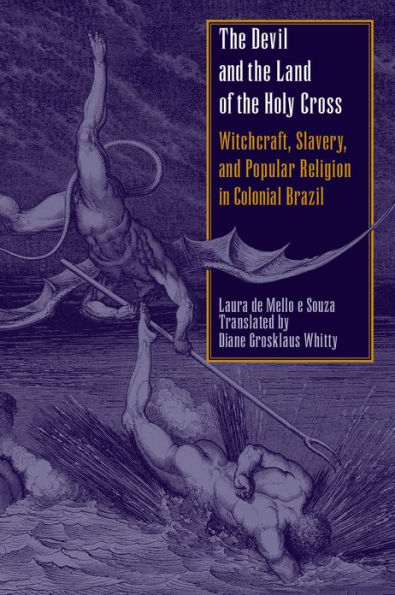
This book began its life as a PhD dissertation in 1986 and was translated out of Portuguese. The translation is good, although Mello e Souza has a rather dense and detailed style.
Part I – ‘A Wealth of Impieties’ sets up the context of the colony, popular religion and economic, political, and religious influences from 1500-1800 in broad terms.
The first chapter is a very thorough literature review (dissertation standard) in which she demonstrates that she’s read nearly everything ever written about her topic, which is a little overwhelming. She begins to develop the hybrid idea of Brazil brought by the colonizers and developed in the colony. Brazil was Purgatory, where the dregs of Portugal were sent to purge and purify themselves, but also a mixture of paradise and hell on Earth, and where European myths and traditions blended with those of indigenous people and enslaved people.
Chapter 2 is on the development of popular religion. Popular Christianity in Brazil at first resembled rural areas in Europe – poorly educated priests, heterodox theology and the very slow consolidation of a Catholic establishment. Medieval ideas, magical ideas, pagan survivals, justification of slavery, and a focus on family and the smaller communities all shaped it.
Syncretic Indigenous-Christianity also quickly arose, by the 1590s. As well, there were Jewish and converso exile groups, whose practices became part of the blend. A strong anti-clerical strain was also part of popular religion. Disease and the forces of nature were often overwhelming and so the popular religion drew from magical elements, propitiating nature and berating God. Adopting the Marian cult and the cult of the saints, syncretized and humanized St. Anthony, St John Baptist (invoked as a fertility god), St. Francis, St. George, and St. Sebastian, beginning in the elite circles in the fifteenth and 16th centuries.
Syncretism broadened after the slave trade began so that Catholic saints were seen to also be African deities, so that the religion that emerged was not Catholic nor African (as the enslaved Africans were from many nations). And winnowing out the African deities that brought fertility and bountiful harvest (both of which would only benefit the slavers) to emphasize the warrior Ogum, judge Xango, and vengeful Exu.
She gives numerous examples of various named individuals who were accused of heresy. And details of their beliefs – the need to enjoy life while here to then enjoy the afterlife. The role of demons and the devil, particular in contestation with the Inquisitors. Indigenous beliefs about numerous spirits transposed into Christian demons by the missionaries. Medieval notions about subjugation of devils which changed with early modernity into the devil as master but lingered in Brazil. A European hell, an African hell, and the hell of syncretism all overlapped.
Portuguese reached Brazil when Christianity in Europe was tightening up – the Council of Trent and a missional push against heretical movements and to enforce orthodoxy in rural areas, the emergence of Protestantism, the increased focus on Satan. Brazil was a complex mix of peoples - Indigenous, Africans, Europeans - to produce complex and original magical practices and sorcery. Add the worship of the economy and of its principal outputs like sugar, tobacco, diamonds - commodity fetishism became a part of the popular religion.
Mello e Souza is more interested in how and through what contexts magical practices came to intermingle than what specific origin points specific practices might have had. At the start, in the sixteenth century, the cultural kinship of sorcery and magic was clear. Their European and Indigenous features combined at the start of the slave trade, and later these features blurred and interpenetrated to produce a single, uniquely colonial body of beliefs and practices with the addition of African elements.
Part II ‘Sorcery, Magical Practices and Daily Life’ now proceeds to detail how this syncretic, colonial magical system worked. She provides numerous details of rituals and magical practices in each of these areas, quoting extensively from documents – Inquisition records, trials, confessions, travellers’ accounts. Chapter 3 Material Survival: divination, healing, superstitious blessings, charms for seafaring. Chapter 4 Onset of Conflict; tension between neighbours, infanticide, tension between master and slave. Chapter 5 Maintaining Bonds of Affection; cartas de tocar, prayers, sortilege. Chapter 6 Communicating with the Supernatural; dreams, metamorphoses, animal familiars, pacts, sabbats, possession, calundus (African-origin rites of exorcism), catimbos (Indigenous rites of possession).
Part III – Culture, Imagination and Everyday Life. Chapter 7 – Intertwined Discourses; witch-hunt and inquisition as Early Modern Nightmares, the Inquisition’s Task – Spreading Persecution and Awakening Memories, the Inquisition’s Task – Hunting Down Pacts with the Devil, Degrading the Colonial Condition, Shattering Human Lives. Chapter 8 – Remarkable Stories; Where Their Roads Led (profiling individuals in some depth). Conclusion – Sabbats and Calundus.
A great strength of this book is the large number of individual stories Mello e Souza brings forward – it is real people using magic drawn from a range of different places to deal with issues in their lives. This large number is sometimes overwhelming and makes the book feel unfocused with her arguments sometimes getting lost in the details.
~review by Samuel Wagar
Author: Laura de Mello e Souza
University of Texas Press, 2003
220 pg. Paperback £25 / $46 Can / $34 US