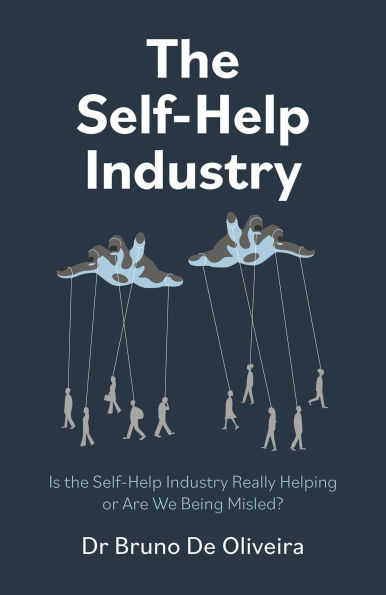
This title appealed to me, because what has come to be described as the self-help industry is ubiquitous in our societies. Many or most of us who practice non-mainstream religions are also interested in the kinds of personal and psychological growth promoted by the self-help industry. We read the books, take the workshops. We practice many of the techniques of self-improvement.
Author Bruno De Oliveira describes the self-help industry as “a global behemoth worth over $11 billion” a year, and as “a panacea for individuals’ myriad personal and societal challenges.” With massive sums of money, the industry’s central message is that you – an isolated individual – can accomplish anything, if you only you will put your mind to it.
De Oliveira doesn’t buy the claims of the self-help industry. He’s an academic from Brazil who lives in the U.K. He works in the field of “collective psychology,” which focuses on community, not individual, agency in addressing the kinds of personal problems that stem from the way our societies are organized. The self-help industry is at odds with the idea of seeing problems as structural and class-based. “The allure of self-help is deeply rooted in the cultural fabric of Western societies,” De Oliveira writes, “particularly in the context of neoliberalism and the emphasis on individualism.”
Whether by design or by effect, the self-help industry promotes ideas about “fixing” oneself, which often entails, also, blaming oneself, while ignoring the economic and political inequalities that yield misery for so many people. Can’t pay your rent or afford to see a doctor? These are problems rooted in inequality, not in faulty thinking.
Like much academic writing, unfortunately, this book is dry, repetitive, and generalized in its assertions. I was hoping for the kind of book that would name the names of “self-help” promoters who do harm. Instead, this book is a generic rendition of the industry’s history and ideology, all worth knowing, though the book is not engaging to read.
The self-help industry arose in the early 20th century “in response to new psychological theories and the changing socio-economic landscape,” the author writes. The early 20th century saw the rise of (Freudian) individual psychology, while the system of capitalism was moving people off of farms, out of communities and into more atomized forms of work and work sites. A significant development was the rise of “positive thinking,” as in the works of Norman Vincent Peale, which “combine Christian ethics with psychological techniques to promote optimism and self-confidence.” Peale’s book The Power of Positive Thinking was a publishing success, with its premise that anyone can achieve success through hard work and a positive attitude.
By the mid-20th century, the work of Abraham Maslow continued to shape the self-help industry, with Maslow’s model of a hierarchy of human needs, beginning with physical sustenance and safety and moving up the ladder to needs for self-actualization. For all its insights, Maslow’s model is nevertheless highly individualistic and paved the way for further neglect of the social roots of personal problems.
From the mid-20th century on, influencers such as Tony Robbins built financial empires by commercializing ideas of self-improvement. The rise of the internet turned the industry into a “sprawling enterprise” that is able to “penetrate diverse demographics.” The self-help industry now overlaps with the even more lucrative “wellness industry” which also turns socially derived problems into matters of individual choice and discipline.
Huge as it is, the self-help industry dovetails with popular spiritual practices, from mindfulness meditation to astrology and tarot. Individualized approaches to “self-improvement” distort and turn these age-old practices into commodified things to buy and to use, stripped out of their long, rich context. With little or no quality control, big-name influencers like Ophra Winfrey have promoted a stratum of gurus, like Deepak Chopra and others, of dubious credibility and ethics.
The late social critic Barbara Ehrenreich used the terms “toxic positivity” and “bright-sidiing” to describe much of what comes out of the self-help industry. If you’re not healing up quick after cancer treatment, maybe it’s because you’re not thinking “positively.” Can’t make ends meet with a dull office job? Maybe you ought to throw caution to the wind and turn your artistic passions into a career; and if doesn’t succeed, it’s your own fault. When it comes to meaningful work, a motto for the self-help industry might be, Don’t organize, visualize.
Yet there’s little counterweight to the juggernaut of the self-help industry. Author De Oliveira cites two examples of community-based organizing for improvements in people’s lives, one in Brazil, one in Harlem, New York. These examples are distinguished by how rare they are.One is left with the sense that, at least for now, all that can be done in the face of a gigantic victim-blaming industry is to reject its tendencies to reduce complex social problems down to marketable products; and to foster networks of mutual aid so that they’ll flourish without motives for profit.
~Sara R. Diamond
Dr. Bruno De Oliveira
IFF Books 2025
178 pg. Paperback $117.95