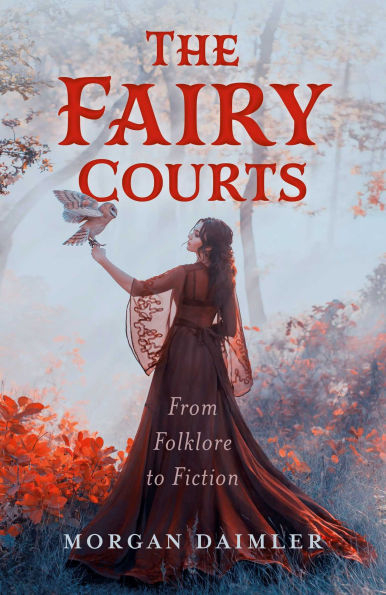
The Fairy Courts: From Folklore to Fiction by Morgan Daimler presents as a carefully researched book on the topic of Scottish fairy lore, specifically the issue of the Seelie and Unseelie courts. These terms may or may not be unfamiliar to readers of folklore or pagan books in general, but as Daimler draws throughout the book, this vocabulary has been adopted with influential if ambiguous effect by writers of urban fantasy since the 1980s and 90s and by role-playing gaming communities since at least the 1970s (think Dungeons & Dragons). The concepts of Seelie and Unseelie fairy courts have older roots going back to the 1500s in Scotland; the terms are specifically Scottish and are derived from the Scots language (with the former meaning essentially “fortunate” or “favorable” and the latter basically the opposite—though, critically, these qualities are not necessarily always intrinsic to each or each so diametrically opposed to the other, as the book takes care to explain). Daimler’s purpose in the book is to provide clarity on the origins and nuances of these terms, their appearance and usage throughout Scottish literature and folklore, and then to address the matter of how these terms and meanings have changed and been translated to good or ill effect in contemporary adaptations. It is a complex and somewhat subtle argument, but Daimler provides the groundwork for it in the first several chapters—on “Social Structure,” “Scottish Fairy Beliefs,” and “The Scottish Fairy Courts”—and then transitions in the final few chapters to the rhetorical points at least suggested if not explicitly advanced. The book, then, serves as a kind of resource for the concept of the Scottish fairy courts, but it also argues for a particular treatment of these complex concepts, which is one of responsible assessment of the Seelie and Unseelie courts as the terms have developed in Scottish folklore since the 1500s.
At the midpoint of the book—chapter 4: “Other Cultures”—Daimler provides a summary review of the concept of the fairy courts as it appears in Ireland, Wales, France, England, the Norse (or more properly “Germanic”) countries, and Romania, and then rounds out the chapter with a quick bit on how the New Age movement has reimagined the fairy courts, from Theosophy and its positing of “ascended masters” in the writings and “channeled material” of John Matthews and David Spangler. Daimler again stresses that the terms Seelie and Unseelie are specific to Scottish folklore, and that the nuances of these classifications within that specific Scottish context are key to an understanding of how contemporary adaptations in gaming and urban fantasy in particular have begun a rather quick and encompassing transformation of these concepts in the twenty-first century imagination. That transformation and translation may be generative in some respects but it is also, as Daimler’s argument makes clear, not without its drawbacks. Rather than basing their understandings of the Seelie and Unseelie courts, and the concept of fairy courts in general, on the existing folklore, a new kind of folklore—what Daimler identifies following Foster and Tolbert as the “folkloresque,” or “popular culture’s own perception and performance of folklore” (cited in Daimler 75)—has begun to emerge and finds great perpetuating force through modern fiction, as well as TV and film, and through urban fantasy genres and the gaming subcultures and communities particularly. Such translations and transformations are not without consequence and not always salutary.
Daimler’s book is the result of “over a decade of focused research and incorporates material from several presentations…given at University conferences,” she states at the very outset. She finds “both the history of the fairy courts and their intersection with modern fiction fascinating,” but “it is also a subject about which there is a lot of confusion. This confusion comes, in part, from the blurring together of various sources and from misinformation that spreads from fiction into active belief,” so, she continues, “this book is intended to help readers navigate the messiness of the subject by offering clear sources for various ideas and discussion of when and how different concepts merged or spread” (Daimler 1). Thus Daimler makes clear right from the beginning that this book is intended not only for informational purposes but also an instructive, or didactic, purpose. It is interesting that in a couple of places in the book she seems to backtrack the rhetorical slant of the book by qualifying that she is “in no way trying to tell anyone what to believe or what they should believe,” and acknowledges that “there are now a wide range of understandings built up around these concepts.” Notwithstanding this new “wide range of understandings,” Daimler stresses that “it’s important to explore the history and to appreciate that the older views still exist as lived belief in many places. The new hasn’t subsumed the old, at least not yet and not fully, but rather these layers of belief exist side by side across communities. To some people the Seelie and Unseelie are still as they have been for the last two hundred years in Scottish folklore, a way to understand fairies as either inclined to help humans or to hurt them” (Daimler 104-105). Daimler’s position seems clear that while acknowledging a new kind of emergence of understanding of old folklore concepts such as the Seelie and Unseelie courts as a result of contemporary fiction and gaming, there is a harm to history and cultural knowledge, as well as, perhaps, a harm and even a danger to those adapting historical folklore with sometimes little regard for the nuances of the terms or the seriousness with which the terms have been regarded historically. I can say at once that I have no problem at all with this position—and it is candidly a concern shared by many historians, and not only scholars of folk belief, fairy lore, comparative mythographers, and literary anthropologists.
All of this is not to condemn those who enjoy reading, watching, or writing and otherwise taking creative part in the generative perpetuation of the concept of the fairy courts, be they Scottish or otherwise, Seelie or Unseelie or whatever other classifications one wishes to conjure. Daimler does not herself condemn any of this, but her analysis does remain at least gently critical and she would have good reason for this, being as she herself describes her spiritual practice as one of “a witch who has been a polytheist since the early 90s” who follows “a path inspired by the Irish Fairy Faith blended with neopagan witchcraft” (Daimler 124: “About the Author”). Daimler is also a prolific author and self-described folklorist, and so her view is clearly informed by a deep scholarly knowledge of many sources both academic and popular, and so there is every reason to assume that as a practicing witch who follows the fairy faith and as a scholar she would care and have some investment in how ideas about fairy courts are understood, received, and applied by contemporary audiences and especially contemporary artists and writers.
“Stories are carriers of cultures and of beliefs,” Daimler observes; “when they are creating new beliefs those beliefs can become widespread, such as we see, for example, with Barrie’s Tinkerbell who became the template of popculture fairies” (Daimler 75). Such an observation is not to condemn contemporary reimagining of fairy lore, be that through the Seelie and Unseelie courts or other classificatory features, but it is to call attention to the power that fiction can have in the transmission of those features—and if a culture is primarily getting its source material through contemporary fiction and game modalities rather than the older folklore itself, and if those newer sources tend to differ radically at times from the earlier lore, then clearly that historical knowledge becomes obscured, sometimes distorted, and ultimately replaced. And that is always a danger, especially in light of the great powers posed in the transmission of cultural information through the mass media of the modern world: TV, film, the Internet, role-playing games, and even book fiction in mass production both in print and digital formats present very different channels of transmission than the oral modes of the earlier folklore especially, all points that Daimler aptly makes. (And this is not even to mention the as yet largely unknown influence of generative AI, which will surely prove also to be a huge and seismic shift in the mass production and transformation of cultural information—including, certainly, folklore.) I think this book is for all of these reasons an important resource and it does present a critical perspective that should be welcomed by many who also hold investments in these ideas and take their folklore and history seriously.
It should also not go unmentioned that after the six chapters that constitute the book’s analysis proper, Daimler puts forward a kind of postscript chapter seven that provides her own counsel on various do’s and don’ts for the reader interacting with the fairy courts. In this final chapter, “A Human’s Guide to Surviving in a Fairy Court,” Daimler begins with several key points of basic fairy etiquette (such as “Don’t lie to the Good People,” “Keep your word,” “Never say thank you,” and “Accept the Hypocrisy of it all”) and then proceeds to specific advice for navigating the fairy courts (examples: the paying of respect, whether Seelie or Unseelie: “offend them and you’re doomed”; “Know your place” and “Know your role”; “Monarchs have different rules except when they don’t”; “Be nice or be ruthless”; and perhaps most importantly, “Trust no one, not even yourself”). It is somewhat unclear whether Daimler is being playful or serious in this chapter—but the advice is fairly detailed on each point advanced, and it is probably best to err on the side of caution with all of the points, in any case. (Also, for all of the reasons stated as advice in this chapter, it is likely all the more critical to have a clear understanding of the fairy courts as put forward in the old folklore rather than to rely on modern reimagining through RPGs and all the urban fantasy that proliferates according to authorial whims and the constantly changing devices of plot.)
The Fairy Courts: From Folklore to Fiction can be read with profit by many different audiences: folklorists, cultural historians, librarians, writers, poets, practicing witches and pagans and by the religious or non-religious, skeptics and scholars and laypersons alike who simply find the concepts of fairies and fairy courts fascinating. Daimler’s book is especially valuable for its focus on the concepts of the Seelie and Unseelie fairy courts in Scottish folklore, for as she notes at the outset, there appears not to be as much work published on this topic and certainly not as widely accessible outside of specialized academic communities. Daimler’s book is, however, academic and scholarly while also being an accessible and readable account of the topic. It is for all of these reasons a valuable resource and is highly recommended by this reviewer. The book also has an excellent bibliography, a glossary of terms, recommendations of fictional books that deal more productively with the concepts of the Seelie courts (by Daimler’s assessment), and detailed endnotes which provide additional clarification for many of the subtler or perhaps more unfamiliar points addressed in the main body of the book itself (including Daimler’s translations from some of the early modern English and Scots passages cited in the text). Personally, I find endnotes rather distracting, and would rather have read this book with footnotes, but such is the author’s choice—and, all in all, other than the odd typo here and there, I found The Fairy Courts to be a thoroughly enjoyable, craftily written, and illuminating read.
~reviewed by Christopher Greiner
Author: Morgan Daimler
Moon Books, 2026
124 pages