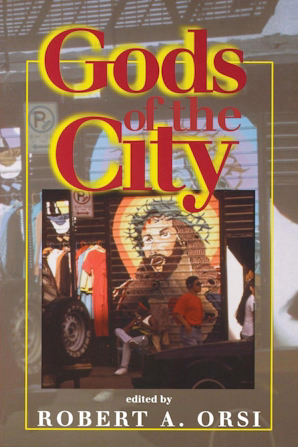
Although the great majority of humanity lives in cities, overwhelmingly so in North America (83% in Canada, 80% in the United States, 80% in Mexico) religion is often thought of as a rural or small-town phenomenon. This collection of scholarship switches the view around to urban religion, seeing the creativity of religion in a multi-ethnic, multi-religious community, examining how the urban landscape helps to shape it and provides a different kind of sacred spaces than what we typically think.
It is particularly strange that so many Pagans think of our traditions as rural in essence and hearken back to a bucolic imaginary Pagan village wise woman archetype, when we are urban people, as were the Greek Pagans of antiquity, the Yoruba Pagans that were the main source of enslaved peoples from which the Afro-diasporic faiths drew, or the Hindus of India. And when the Renaissance and Victorian Western magical traditions which we draw upon heavily were both products of well-educated urbanites.
Orsi’s excellent collection reminds us that the sacred is right here, where we are, and that the day-to-day spaces of our apartments, gardens, the streets of our neighbourhoods and local parks can be places to celebrate the Mysteries and honour the gods.
The contributors talk about Haitian vodou in shrines and observance in the middle of New York City, Hindu temples in suburban Washington, Catholic shrines and religious processions in large cities, apartment shrines to the orishas and properly housing and worshipping them in small spaces, Jewish remnant congregations in neighbourhoods populated with newer immigrant groups, transplanted Japanese Christians, and the Salvation Army’s use of open-air meetings in urban areas. Because one of the exciting facts of life in the city is religious variety, hybridity, as groups from around the world meet, exchange ideas, cross-fertilize and bring forward new religious understanding, new forms for the sacred.
So much better, so much healthier and more interesting, than the monocultures of rural areas. Rather than escaping our lives, looking for meaning and connection elsewhere, let’s embrace the possibilities where we are!
~review by Samuel Wagar
Editor: Robert Orsi
University of Indiana Press, 1999
311 pg. Paperback £20 / $37 Can / $27 US