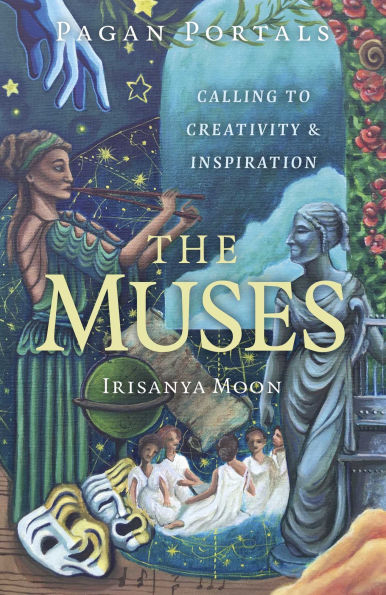
Irisanya Moon is clearly an author who knows something of the blessings and gifts of the Muses. Her latest book, The Muses: Calling to Creativity & Inspiration (part of the Pagan Portals series), is I believe the eleventh book she has published, and it is now the ninth book of hers that I will have reviewed. (Evidently, I find her books inspiring.) Moon has been “a professional writer across genres since 2005,” and indeed in that time she has developed a kind of brand for herself as an author. She writes short devotional works about a goddess figure (e.g., Aphrodite, Iris, Artemis), provides historical and mythic background, and then discusses ways in which a reader can cultivate a personal relationship with the deity in his or her own daily spiritual practice. Clearly, this format has proven productive for the author, and Moon applies the formula to positive effect in The Muses .
The book is fairly short, just shy of 100 pages, and divided into eight chapters. In the first chapter, Moon notes that the book could be read from cover to cover, or the reader could feel free to skip to the end chapter on “Cultivating a Relationship with the Muses.” I decided to read the book in both ways: first I skipped to the final chapter, and then I came back and read the entire book from chapter 2 through to the end. And I am glad I did that, not only because a responsible review at the least should generally look at the entire book, but also because it is in the chapters between the first and the last that I found the most enjoyment. Chapters 2 through 4 are especially informative: for not only does Moon discuss the historical and mythic background of the Muses (whose number is canonically nine but other sources have varied from three to four, and with different names for the Muses and different parentages and provinces for them). But in chapter 4 especially, “Stories & Myths of the Muses,” the reader is treated to a rare glimpse of the Muses as characters in their own right, personalities who can experience grief or anger and jealousy, and express mourning or exact vengeance for any perceived slight to their supremacy (note the great cautionary tale of Thamyris; the Muses also set the Sirens in their place for their vaunted musical hubris—a fascinating note, indeed). The Muses also can show great pity, as when they sang for seventeen days and nights at the funeral of Achilles (“No one could keep from crying at the sound, so moving was their song”). I learned much from these chapters, and found myself a fair bit more informed on the complexities and varied gifts of the Muses than I was when I started the book.
As a poet and writer, myself, I certainly appreciate thinking about the ways in which the Muses can inspire creativity. Moon in many ways, though, democratizes the Muses, meaning that in her view the Muses don’t exist merely or even mainly to inspire writers and poets and other artists in any “high calling” sense. I can appreciate that perspective, too, though I would caution that traditionally that has in fact been the case, as poetry especially has been regarded as a high and even sacred calling—shamanic, druidic, always magical and at least partly divinely inspired. And if it were not seen in such a way, why would there be any need for calling on, or even inventing, the Muses in the first place? The Muses may, as Moon suggests, bestow their blessings on whom they will and make their presence known even in the most ordinary acts, but surely there is one way of talking about the Muse that inspired, say, Homer or Milton, and another of the muse that inspired John or Julie to book that vacation or buy that new car they’d always wanted. That said, it is nice to think of the Muses as deities or figures that all of us can connect with in cultivating creativity and a more inspired sense of living our daily lives and dreams. I will maintain my own sense of the sacred nature of poetry and the relationship that I have with the Muses on that basis, but I don’t take away from the more secular or democratic reading, and I am happy to recommend this book, which should appeal widely to pagans, poets, writers, artists, and anyone else who desires a stronger connection with the blessings and magic the Muses offer. Cultivating creativity and inspiration is always a worthy and noble investment.
On a final and somewhat personal note, I found it interesting that Moon mentions as one of her earliest memories of how she learned to connect with the Muses, “sitting in a conference hall, listening to Thomas Moore speak about embracing your daimon, an energy that was waiting for you to hear so it could tell you what you were on this earth to do” (Moon 2). Thomas Moore, it so happens, is an author I first read way back in college, now over twenty-six years ago. I found his 1992 book Care of the Soul: A Guide to Cultivating Depth and Sacredness in Everyday Life and a couple of follow-up books to be very inspiring, and I still love the way that Moore draws on myth and archetypal psychology to explain the poetic complexities and paradoxes of the human soul. The fact that Moon would invoke Thomas Moore in a book about the Muses not only seems very apt to me as one who is familiar with Moore’s writing, but it also brings in some way full circle a key element in my own developing craft, that of weaving the threads of life and fate and finding one’s own voice and place “in the wyrd,” to borrow a phrase of Moon’s from her book on the Norns. It is all very fascinating and even poetic to me. Inspired by this—and by, I suppose, the Muses in the forms of Moon and Moore—I leafed through my old copy of Care of the Soul , and alighted upon this passage from Chapter 10: The Need for Myth, Ritual, and a Spiritual Life: “An appreciation for vernacular spirituality is important because without it our idealization of the holy, making it precious and too removed from life, can actually obstruct a genuine sensitivity to what is sacred” (Moore 215). Thus do the Muses inspire in mysterious ways. I know that this day I would not have bothered to reread this passage from Thomas Moore, if Irisanya Moon had not mentioned him, had not all those years back been herself inspired by him, and if I had not thought deeply enough about this book of hers about the blessings and gifts of the Muses. As Emily Dickinson, that gifted poet and inspired muse to many, including Mr. Moore, wrote, “Witchcraft is wiser than we.”
~review by Christopher Greiner
Author: Irisanya Moon
Moon Books, 2026
120 pg. Paperback $12/95