Witchcraft is endlessly adaptable, borrowing ideas, materials and techniques, transforming whatever power structures exist into tools. I am finding it interesting to read about modern witchcraft in Africa and the ways that modernity - the marketplace, money, bureaucracy and government, the lot - has provided structures for witchcraft and new symbols to work with. It's not just Ren Faire cosplay!
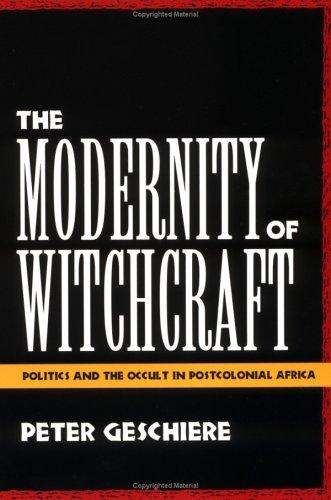
And, significantly, it is both a tool for resistance to the powers that be and one that is harnessed by various post-colonial national governments and political movements to consolidate their authority. As well, it is not purely rural or in the least modern areas of Africa, but is found in cities, coexisting with and integrated into the web of modern life, part of entrepreneurship, politics and economic competition. Witchcraft is dynamic and effective, not a nostalgic traditional holdover. Peter Geschiere very effectively challenges the divisions between traditional and modern culture and religion and politics, at least in the context of his study in Cameroon.
Geschiere’s book is based in more than twenty years of fieldwork among the Maka people in eastern Cameroon. He is particularly interested in overlaps between politics and witchcraft on both the local and national levels. There are fascinating parallels and insights about occult beliefs and practices in Africa today and our lives in late capitalist North America. In Africa the witches eat the substance of others and thus cause them ill-health and misfortune for their own profit, rather like the capitalist class in relation to the workers. But because this is the nature of power itself, it is also necessary to engage with the occult for successful leadership and the defense of collective interests.
The state and politics breed modern transformations of witchcraft, with backroom deals and public relations hiding power struggles and thus resembling the occult. Witchcraft as both a resource for the powerful and a weapon for the weak, is not fundamentally a conservative force limited to the rural and village smaller scale of operation, as Geschiere demonstrates. There is also constant cultural and material borrowing and innovation, with the interest in modern imported goods feeding into new forms of witchcraft.
Some elements of Cameroonian witchcraft are familiar tropes to those who know the history of European witchcraft accusations – inversion of social norms with homosexual orgies at nocturnal gatherings of witches, astral projection, cannibalism accusations. In African witchcraft, the witches first gain power by consuming the power of members of their families and the central metaphor of occult power there is eating, not sex, and there are no pacts with a devil. The witches are in competition with one another for greater power and alliances between the factions of witches are temporary.
There are also nkong, healers who are powerful witches, both women and men, marginal individuals and sometimes genderqueer, resembling the cunning men and wise women of European tradition, and groups of anti-witchers who combat witches while in trance at night, resembling Carlos Ginsberg’s benandanti in early modern Europe. These are not the neo-Pagan Wiccans and New Age ‘lightworkers’ but the substantially more dangerous and deeper currents of power.
His discussion of circular reasoning in thinking about witchcraft reminded me very much of conspiracy theory thinking in our culture – all evidence is turned back to reinforcing belief in witchcraft. He talks about how djambe, magical power, is everywhere and how one must participate in it in some way to protect oneself or gain power. This reminded me of Favre-Saada’s study of witchcraft in Normandy, where the options are to either be a witch or an unwitcher once you learn about magic but not to step outside of the system of occult power altogether.Geschiere’s detailed history of Cameroon’s politics and of the specific forms of witchcraft beliefs of the Maka are balanced by broader discussion of witchcraft in other Cameroonian and African cultures. He has a fine conclusion summarizing his findings on the integration of politics and witchcraft and an interesting discussion of anthropological discourses on witchcraft, in which he addresses the lack of scholarship on modern witchcraft in Africa and recent trends in the area.
~review by Samuel Wagar
Author: Peter Geschiere (trans Peter Geschiere and Janet Roitman)
University of Virginia Press, 1997
311 pg. Paperback £25 / $46 Can / $34 US