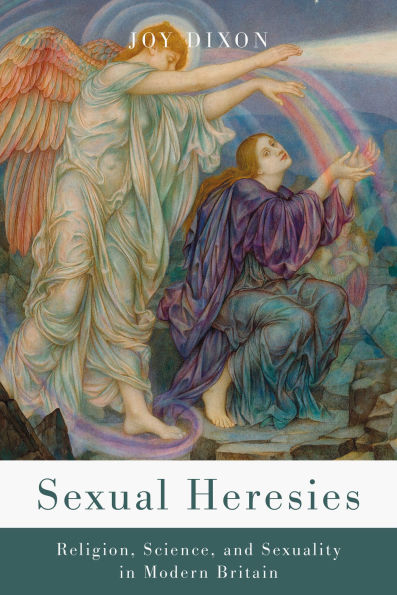
A little out of our usual fare here, related to but not principally dealing with esoteric, occult, Pagan movements. This is an intellectual history of the impact of the rise of psychology and particularly the scientific study of sex on religion in Britain between the 1880s and 1930s and the emergence of new sexual theologies in response.
Dixon deals in some depth with Catholics and Anglicans and other Christians principally but also has a very interesting discussion of some esoteric and occultist groups and authors, such as Dion Fortune and Aleister Crowley, and secular critics of religion. She argues that a key factor in the transformation of religion in Britain was the dialogue between the scientific study of sexuality and religion which not only changed what religion had to say about sex but the nature of religion itself. A result of this ferment was creating both ‘normal’ sexuality (heterosexual, monogamous, reproductive) and ‘normal’ religion (rational, calm, not enthusiastic or ecstatic) and defining the ‘abnormal’ as heretical.
After her thorough introduction, in chapter one Dixon lays the foundations with James Frazer’s Orientalist and colonial armchair anthropology, Havelock Ellis’ biological sexology, Ernest Jones’ Freudian psychology, and the British Society for the Study of Sex Psychology (with such luminaries as Edward Carpenter, Jones, Ellis, E. E. Evans-Pritchard and others as members).The religious intellectuals sprang forward to make sense of ferment and churn in late Victorian British religion. There was a lot of rethinking going on, with modernism in general, influences coming back to Britain from the Empire, Darwin, liberal theologies centred on incarnational theology (Christ as man) contending with the evangelical emphasis on atonement (Christ as sacrifice for sin) and the new Biblical criticism, along with such as Havelock Ellis and the birth of psychotherapy which said that everything is sex (Freud notably labelling all religion as sublimation).
The Catholics basically put a lid on it after a while, as the Pope condemned modernist theological speculation and affirmed Thomist theology of ‘sameness’ (the souls of women and men are essentially the same), challenged individual religious experience as a source of spiritual authority (a position that remained important in Protestant theology), and affirmed the Catholic emphasis on community understanding and tradition in contrast to Protestant individualism. Popular Catholic author George Tyrrell promoted chastity regardless of the object of desire.
Anglicans continued to wrestle with these issues and made some creative syntheses, which Dixon presents in some detail. In chapter two she brings in three interwar Anglicans – Dean Inge, Rev. Charles Rave, and Evelyn Underhill, all domesticating mysticism to fit it into 'normal' heterosexual monogamy (if there were any sex left there). Chapter four substantially deals with Anglican and other Christian sexual theologies – the evangelical wing and the Anglo-Catholic wing as well as Baptist preacher Charles Spurgeon’s ‘muscular Christianity’ and the Holiness theology of the Salvation Army.
Dixon deals with a lot of writers and organizations that were significant at the time (1880s to 1930s) but have faded and some like James Frazer, William James, Evelyn Underhill, Friedrich Nietzsche that are still influential. She introduced me to many of them and gave a different lens to view people and movements I had previously been aware of. What a fascinating and complex stew of influences at the time – not only emerging psychology and evolution with scientific racism, eugenics, and colonialism, the feminist movement and reaction against it, secular free love and free expression ideas, and individualist and communal currents.
In chapter three the esoteric currents come into the picture, opening with the Leadbeater affair in the Theosophical Society (pederasty and sodomy by a religious leader and the complicated sexual theology of Theosophy) and discussing the esoteric emphasis on the gender binary, sex as religious sacrament, essentialism, moving from emphasizing ‘sameness’ to difference. She discusses Dion Fortune and the Fraternity of the Inner Light and Aleister Crowley’s Thelema, co-Masonry, Paschal Randolph, and a small esoteric society around the journal Urania that rejected the gender binary and even sex completely.
Sexual desire, sexual difference, both emphasizing the gender polarity and collapsing and denying it were all facets of this complex cultural ferment. The clear discussion of both sexuality and religion as historically contingent and contested is insightful and provides a continuing thread of argument through a complex web of sources and discussion. Policing the boundaries between what was considered sexually normal and abnormal was linked to concern about spiritual deviance and spiritual normalcy. At this time the notion of the homosexual and then the heterosexual (as a sexual identity rather than individual acts) emerged, and a great deal of religious teaching that was aimed at keeping men ‘pure’ and in ‘normal’ heterosexual monogamous marriages.
Chapter five focuses on secularist movements and their various critiques of Christianity, including two homosexual male “Pagan” authors; Norman Douglas, who advocated reviving Greek pederasty, and George Ives, the founder of the Order of Chaeronea (a secret society for homosexual men, which he saw as a new faith, based in a pagan erotic mysticism). Dixon concludes with brief accounts of two figures that brought together many of the contradictory threads of this spiritual and sexual rethinking – W. T. Stead, the theologically liberal and sexually conservative social purity advocate of the 1880s, and Radclyffe Hall, the out lesbian novelist and devout Catholic in the 1920s. These two bookended the period she deals with and illustrated the continuing negotiation of sexual theologies and the heresies in both realms.
I found it slow going because she presents a great deal of information that was completely new to me, particularly on Catholic and Anglican sexology, and I was taking copious notes, which slowed me down. It's very good, her scholarship is first rate, there are substantial notes and an extensive bibliography for follow-up. However, the book is too short – I wanted her to expand her discussion, and I see Sexual Heresies as opening a field not as the final word.
~Samuel Wagner
Author: Joy Dixon
Stanford University Press, 2026
342 pg. Paperback £25 / $44 Can / $33 US