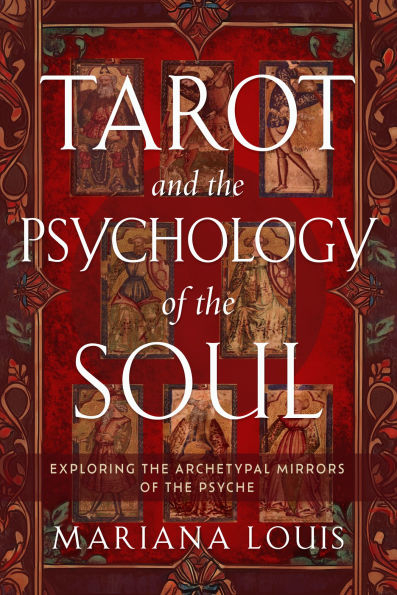
Author Mariana Louis calls her work an archetypal psychological approach to tarot, as the cards are “windows of communication between the conscious and unconscious” mind. Louis doesn’t discount tarot’s usefulness “for predictive divination or even encouraging self-care.” Her focus, though, is on tarot “as a tool to support our individuation, the psycho-spiritual process of self-becoming.”
Louis is among many tarot practitioners who situate their work within the framework of Jungian psychological theory. This book explains why it is useful to work with tarot this way. It’s also a pleasure to read. In her youth, Louis was headed toward a career as a musical and theatric performer when she happened to find, in her grandfather’s library, a copy of Carl Jung’s The Undiscovered Self. Reading that book launched her on a quest for answers to what may be the most meaningful of all human questions: “What am I meant to do with my life?” She embarked on years of what she calls a “storm of study,” earning a master’s degree in western intellectual traditions. She’s based in New York, teaches tarot worldwide and co-hosts a podcast called Soror Mystica.
The book begins with a primer about Jungian psychology, including key terms. An archetype, for one, is “not a fixed identity but a container for a fundamental expression of human experience.” Everyone has in their psyche a blueprint or an intuitive understanding of what Plato called Forms: things like friendship, father, mother, or individual will. Jungian depth psychology, Louis writes, “is, at its core, about the process of individuation… the practical effort of differentiating our unique selves from the masses…” as well as “the mystical pursuit of reconciliation between ego and Self.”
In practice, tarot is well understood as an art of divination. In Jungian theory, divination is a form of synchronicity, defined as meaningful coincidence, with an emphasis not so much on events, but on their meaning. As the cards are drawn and laid out, they point to both inner and outer realities, by working “through the undetectable, ineffable, mystical connection between psyche and matter.”
Part 2 of Louis’ book moves from archetypal theory to the cards themselves. She begins with the Minor Arcana pip cards because “while the Major Arcana guide us through the quest of individuation, the Minor Arcana show us the dynamics of our psyches, revealing its inner conflicts, strengths, processes, and neuroses.” The Minor Arcana are mundane, not sublime.
Louis demonstrates how to understand the pip cards along three dimensions. The first dimension, derived from Jung’s theory of personality, is the set of four cognitive functions, which correspond to four elements and suits. These are: thinking/air/swords; feeling/water/cups; sensation/earth/pentacles; and intuition/fire/wands. The second dimension is the numbers 1 through 10, representing themes from unity, to opposition, synthesis, and so on through completion. Thirdly, the pip cards reflect the universal psychic monomyth that resides in human consciousness as an archetypal story. Joseph Campbell theorized that cross-culturally, people intuitively recognize a monomyth, what he calls the “hero’s journey.” It starts with a call to adventure, and procedes through ordeals, rewards, and endings. (I’m summarizing.) The pip cards take a tarot user through the phases of the hero’s journey, differently for each suit/element/cognitive style.
Louis then applies her three-pronged approach to each pip card, with a user-friendly half-page or more about each card, the illustrations from the Smith-Rider-Waite deck.
She works similarly with the court cards. A traditional approach might cast the court characters as representing people in the querent’s life. By contrast, “a psycho-spiritual orientation makes the courts not only more approachable, but often the most illuminating cards in a spread.” Rather than representing people out there, they “show us the array of subpersonalities that are alive and active within us all.”
The court cards “give a face” to “energies within us,” including the complexes that are made up of our deepest wounds and “most challenging behaviors and beliefs.” Take the Queen of Cups, for example. This card “shows us embracing ourselves and others with unconditional love and understanding.” She can also “appear in us as the mother figure who is profoundly loving or profoundly selfish, “or that we “must embody this Queen ourselves, particularly if we are in a role of emotional tending or support for others.”
When it comes to the Major Arcana, Louis writes that “there is no better model for individuation” because “if we can map out the twenty-two keys on this symbolic journey, we might truly understand this noble quest that we are all on.”
Louis places the Fool, the card without number, at the end of the sequence because “it is only after we’ve gone through this impossible, incredible journey that we are ready to understand what the Fool is all about. The Fool is foolish because he is individuated.”For each of the archetypal trump cards, Louis offers a beautiful, Jungian interpretation, followed by possibilities for dialogue with oneself or another querent, and how to work with the card when reversed.
As for interpreting the cards once they’re laid out, her archetypal approach is to do a three-part exercise of: 1) contextualization—considering one’s current circumstances and past patterns; 2) personalization, of one’s unique experiences, feelings and responses; and 3) amplification, “investigating the relevant symbolic elements and archetypal significances.” Returning to Jung’s four-fold typology of cognitive functions, she reminds the reader that “Just as the Magician’s full creativity engages all four suits on his table,” we should engage our thinking function, as well as our emotional, sensate, and intuitive functions.
Louis concludes her book with a meditation on how often what we’re asking of the cards is to bring clarity. She says she has “become suspicious of this intention,” because clarity means removing ambiguity and obscurity; and in life, there are no true and final answers. Nor does continuing to have questions pose a crisis. Asking for clarity is like asking the cards for a prescription for what to do, how and when. “We want to resolve the tension of living, but the tarot does not have this power, nor is it meant to be.”
Louis urges readers to keep asking more and better questions, to “let the cards confuse us so that we may voyage toward expanded understanding. True, lasting clarity is best won through contemplation of our confusion.”
This is a book to keep and to consult.
~reviewed by: Sara R. Diamond
Author: Mariana Louis
Weiser Books, 2026
311 pages