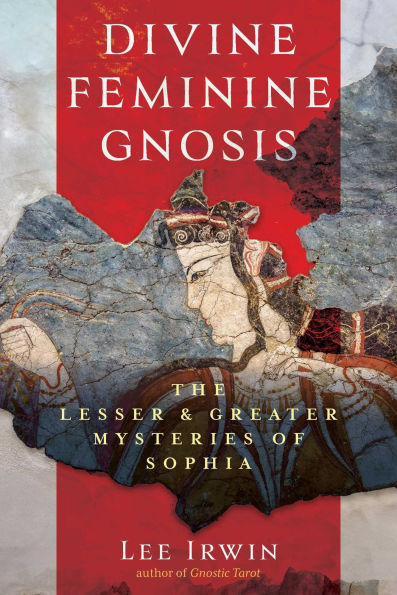
This book is a guide for contemplating and cultivating divine wisdom. The sacred writings of the world’s religions point to the qualities of wisdom. But these writings “arise from a masculine attitude that wishes to reify these written texts as the ultimate expressions of truth and revelation.” Approaching a pursuit of wisdom raises an inherent paradox in that “these mysteries require words and yet cannot be fully explained by words.”
Divine Feminine Gnosis captures something underway, a “global movement,” as author Lee Irwin terms it, that’s a departure from societies’ millennia-long pattern of treating what sacred texts say about wisdom as if the ideas are “real, material, actual, and unquestionably true expressions of what is and shall be.”
The author Lee Irwin is a man. His lens on wisdom is feminine, as in receptive. He’s a professor emeritus of comparative religious studies. He’s a practitioner in a number of esoteric streams, including the universalist Inayati Order of Sufism and the Ancient Mystical Order of Rosicrucians. The word Sufi, of course, is akin to the Goddess name Sophia; both mean wisdom. Divine Feminine Gnosis is a work of phil-osophy, the love of wisdom.
Irwin’s proposition isn’t that wisdom can’t be meaningfully conveyed in writing. What he’s pointing to is a feminine wisdom he calls Sophianic Knowledge, that arises and flourishes through “direct participant knowing.” He observes that in our times, a “host of women” are creating analyses, works of art, and books that are giving “form and content to new spiritualities,” which are much more diverse and inclusive than “the older patriarchal values of exclusion and convergence.”
Irwin’s the author of a trove of books on subjects ranging from tarot to Native American spirituality and prophecy, to Christian mysticism, to altered states. His research and practice are wide-ranging. He calls himself an “apostle of wisdom.”
What is wisdom? Irwin writes that:
Wisdom is not a content nor a system of beliefs; it is not reducible to an explicit set of maxims nor aligned with explicit states of mind. Wisdom is a free-flowing spontaneous intuition that cuts through the morass of beliefs and mental fixations and gives birth to creative, generative patterns of meaning. Sometimes very specific and precise and at other times broad and inclusive. Wisdom is contextual and transcendent; it is fully present both within and beyond the rational boundary.
Wisdom, Irwin writes, is “not a single tree but a world of trees, and to cultivate it “requires education.”
Toward such an education, Divine Feminine Gnosis is organized into chapters around what Irwin calls “lesser” and “greater” mysteries. The “lesser” mysteries are no less important. They are the areas of daily life—body, mind and soul, “three unfathomable aspects of human experience, none of which can be fully described or defined through language.” The “greater mysteries” form “a hidden domain of experience whose contents and forms are less substantial in terms of everyday meaning but more powerful in terms of application and embodiment.” Accessing any of the mysteries requires faith which “is fundamental to Sophianic knowledge.” Faith “is a disposition to hold open a horizon of possible knowing as yet unseen but forthcoming… not a belief system, nor a set of specific truths that remain unproven.”
As I read on to find the book’s central themes about wisdom’s mysteries, I was struck by Irwin’s writing. It’s so lyrical that I found myself letting go of my usual way of reading, which is linear and with a habitual expectation that I will quickly extract an author’s central thesis and sub-theses and then use my mental skills to analyze the validity of the author’s points.
Instead, I was drawn into sync with the book’s premise, that divine wisdom isn’t about collecting facts and molding them into a specific form. Once I got beyond the first few chapters, I surrendered to a more Sophianic way of reading. Instead of reading for analysis, I enjoyed the beauty of many passages, marking them with pencil and post-its to return to for inspiration.
In the chapter on the Praxis of Incarnation, I read about viewing the body as a temple, to heed a Sophianic call to “leave a small footprint, to not mar or undermine the intrinsic beauty and wholeness of our planetary home.” I read that the “primary basis” for the arising of a Feminine Wisdom is in “care and concern for others…being motivated to maintain a quality of life that is not based on success or happiness but upon the shared satisfaction of basic needs that do not privilege either wealth or status.” And, Irwin notes, what he’s advocating is no “covert socialist agenda” that would promote “equality” at “the expense of suppressing individual skills, talents, or accomplishments.” That’s because basic needs aren’t just food, shelter and services but also love, family, meaningful work and “intelligent appreciation for diversity and difference.”
In his chapter on the Mystery of Deep Union, I read about the relationship between Christ and Sophia and the “texts that teach that Mary Magdalene was one of the most advanced students of Jesus [who] questioned him deeply and interpreted many sacred writings correctly and profoundly.” There’s a tradition, even within Christianity, “in which the feminine played a more important, even central, role than usually recognized by the masculine hierarchies of the church.” May this tradition be revived.
I read about the World Soul as a pattern of sentience, responsive and adaptive, a “complex theory integral to ecological, spiritual and psychic development trends.” All of life is participating on some level in a shared reality. I savored a new term, pansentience, describing “the total field of all sentient beings and all sentient processes.” Gnosis, or knowledge, Irwin repeats, is more than content. It’s “a participatory event, a process encounter by which the seeker becomes aware of a living relationship to the larger cosmos.” Over and over, the themes of the mysteries are what the mystics teach: wisdom is experienced as unity within diversity. Wisdom’s not a maxim or a precept, but a felt sense.
Felt, Professor Irwin concludes, perhaps most readily in silence, as “words are only one means” and “every media has its limits,” whereas silence is “the ground of sentience” and the necessary “precursor for Wisdom’s forthcoming.”
~review by Sara R. Diamond
Author: Lee Irwin
Inner Traditions, 2025
284 pages, $22.99