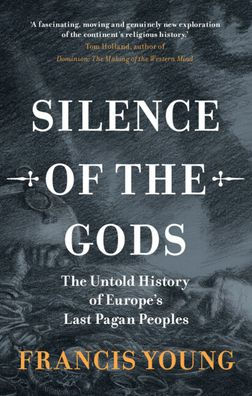
Eastern Europe was the last part of the continent to be Christianized, with the Grand Duchy of Lithuania being officially converted to Roman Catholicism in 1387 with the conversion of the capital city and the destruction of the pagan temples and holy places there, several hundred years after the Western parts of Europe. However, large parts of the population of Eastern Europe were untouched by that conversion, and it was at least five hundred years longer before the pagans, particularly in the north and east, were more-or-less fully converted. As Young describes, the Christianity of the East, certainly the folk Christian religion of the common people, was a group of creole religions syncretising ideas and practices from their pre-Christian pasts with Christian ideas, becoming more orthodox over time in most cases.
Young begins with a critical discussion of the historiography which underplays the experiences of people in Eastern Europe in the study of religious history, for various reasons including lack of translated materials from Slavic or Finno-Ugric languages, lack of access to primary sources, Western Eurocentrism that disregarded the Eastern experiences, romantic notions about pagan survivals that attempt to shoehorn a wide variety of hybrid religions into a mythical single religion of the Great Mother (and Her Consort) and which downplayed the adaptability and creole qualities of pagan survivals. He emphasizes the agency of non-Christians as they borrowed ideas that worked, discarded ones that didn’t, kept and adapted from the past. Notably, Young challenges cherished neo-Pagan notions about the reliability of folklore collections from the late 19th and early 20th centuries in reconstructing the actual pre-Christian religions of various areas.
There are several slowly Christianized groups that Young deals with in greater or lesser detail across a large geographic area, with numerous languages and a great range of source material. The book is divided in broadly chronological order by century after the historiographic opening chapter and the first chapter which traces the formal conversion of the European peoples (generally first only kings, nobility, and major cities) in several phases prior to 1387. One notable factor was the variety within Christianity as well – the Arians of the 5th century, the Roman Catholics, the Orthodox churches – and pressure from Muslims in the east and the Golden Horde. Chapters 2-6 cover the 15th to 19th centuries dealing in turn with the various un-Christianised peoples still existing in that century and the broad trends of interpretation of the pagan survivals current in that time (Ch. 2 Curiosity and Ethnography, 3 (counter)-Reformation in Unchristianised Europe, 4 Antiquarians and Witch-hunters, 5 Pre-Christian Religion in Enlightenment, 6 Folklore and Fantasy – Reinvention of Paganism). His final chapter deals with the post-Christian future of Europe and how we may see religious innovations of our time and the future considering this history of adaptation and hybridity.
Many of these peoples, the Karelians, Nonets, Kumi, Maris, Chuvash and others, will be unfamiliar to Western Europeans although some like the Saami of northern Scandinavia, the Baltic peoples – Latvians, Estonians, Lithuanians, Prussians – will be familiar. Young pays lesser attention to collections of mythology, songs and stories, and the names of goddesses and gods, and the revivals presently underway, notably in the Baltic states. His principal interest is the history of contacts and conquest, the adaptation of ritual and practices and their persistence to the 20th century. He cites a great deal of primary source material from missionary accounts, early ethnographies, and carefully evaluated eighteenth century antiquarian and nineteenth century folklore collections and translates much of it himself.
I am so pleased to be able to explore this whole new spiritual and historical landscape. There has recently been an increased interest in Eastern European traditions, folklore, and religion and a goodly number of knowledgeable authors publishing in the area. Young is a very well-published historian and folklorist not a neo-Pagan or New Age popularizer and his book is a valuable general history of Christianisation in Eastern Europe. He’s definitely a historian, with a great attention to his sources, discussion of their validity, and academic chops, but Silence of the Gods is an interesting read with a minimum of academese.
~review by Samuel Wagar
Author: Francis Young
Cambridge University Press, 2025
432 pg. Hardbound £25 / $46 Can / $36 US