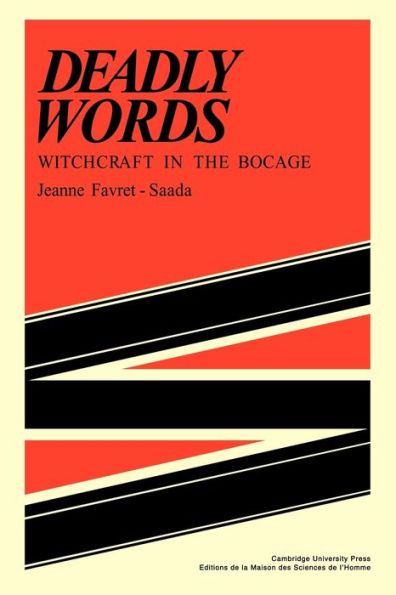
In the late 1960s and early 1970s, a young ethnographer, Favret-Saada, went to a rural area of Normandy in western France to study witchcraft beliefs and experiences of peasant farmers. Witchcraft was an integral part of the life of rural Normandy, as recently as this.
Here, being bewitched is being caught up in a sequence of misfortunes, not just one thing. The culprit is someone in the neighbourhood: the witch, who can cast a spell with a word, a touch or a look, and whose power comes from a book of spells inherited from an ancestor. It is based in the idea of personal power and ‘force’, which are part of all interactions. There is no way to escape power exchange if you interact with others. And witches are not benevolent but powerful and malevolent, effectively draining their victims of their life energies as psychic vampires.
She discovered, after several fruitless months, that the only way to learn about witchcraft was to participate, to be caught up in it, to either be a malevolent magic-user (a classic witch) or a professional magician, an ‘unwitcher’, who undertakes battles of magic with the suspected witches, battles which are eventually fatal. This sort of folk magic is the norm wherever there are cunning women and wise men – among their jobs is protecting the community from malevolent magic users (as see, for example, Carlo Ginzburg The Night Battles). It was only when she was accepted in the community as an unwitcher, a status she acquired accidentally, that she was able to learn from the people there.
Witchcraft survived as a supplement to other sources of explanation; not primarily why unfortunate or unexpected things happen. Witchcraft “gives a pattern to misfortunes which are repeated and range over the persons and belongings” (6) but generally only after people have exhausted the mundane explanations. When a bunch of unrelated bad things happened at once, which can only partly be explained by medicine or religion, people looked to a supernatural explanation and cure.
Interesting elements of this folk witchcraft described by Favret-Saada contradict neo-Pagan ideas. It doesn’t use formal rituals, operating primarily through spoken words, not spells because the content of those words is not very important but rather the intent, which can be completely hidden from the observer. It’s also not a group activity – witches act alone to benefit themselves. Unwitchers were also seen as dangerous people with a great deal of force, who could not necessarily be trusted.
Another interesting aspect is the physical presence of magic in the witch’s body. Magical power sometimes operates from powerful objects but is produced through spoken words. It attacks the family, land and possessions of the person being bewitched. The family is the primary source of tensions in these communities (e.g., inheritance, sexual discrimination) that are the principal sources of social violence, hatred and ill-will, but it is neighbours who are the source of witchcraft and its resolution. As Favret-Saada writes, one key role of witchcraft in the Bocage is settling family dramas of inheritance and resource-sharing.
Favret-Saada recounts stories in the words of those who experienced being caught in spells and seeking the aid of an unwitcher. She also gives details of unwitching as a profession, and techniques for counter-cursing witches to defeat them, as well as numerous examples of folk magic spells. A fascinating aspect of her accounts is her recognition of how she sometimes simply didn’t hear what her informants were telling her because she lacked the cultural context (a typical issue in ethnography). Sorcerers and spells were talked about through euphemisms (“we are caught”, “someone fell on us” – rather as faeries are called “the fair folk” to avoid attracting their attention). Because of the power of words, Favret-Saada had to know how to signal shared beliefs without directly naming them to study and understand witchcraft.
This is a dense ethnography, with complex and layered analysis and substantial interview quotations. Not a casual or easy read, but fascinating because the culture is both so near and so far away from Western modernity.
~review by Samuel Wagar
Author: Jeanne Favret-Saada
translated by Catherine Cullen
Cambridge University Press, 1980
273 pg. Paperback £34 / $63 Can / $45 US