The Minoan civilization has fascinated the world since Arthur Evans’s landmark excavations at Knossos at the turn of the twentieth century. After more than a hundred years of careful, systematic archaeological work, it is clear that the Neolithic people who crossed the Mediterranean and settled in the islands of Crete and Thera continue to fascinate, mystify, puzzle, and inspire. Many books have been written about the Minoans—both scholarly and fanciful, from Arthur Evans to Robert Graves—and archaeological theories about the Minoans continue to evolve. The Minoans have been understood and portrayed as everything from an offshoot of Atlantis to the forerunners of European civilization. Despite a rich body of artifacts and architectural remains, few intact records have been uncovered and their written language, Cretan hieroglyphs and Linear A, remains undeciphered. All of these factors make for a rich subject for scholarly investigation and creative reconstruction alike. The final word on Minoan civilization has far from been entered into the annals of history. And certainly it is a subject ripe for poetic experiment as well.
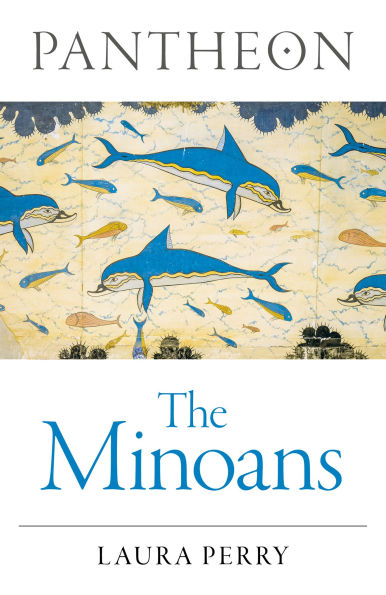
Laura Perry takes up the torch, and pen, in Pantheon: The Minoans. Longer than many others published by Moon Books, Perry’s book is intended as an introduction to the Minoan world, with an emphasis on the deities and ritual practices, such as may be guessed at or inferred from the archaeological evidence, and secondarily from mythic portrayals by the Mycenaeans and the Greeks.
After two short chapters on Minoan history and worldview, Perry moves into the longest chapter on “The Family of Deities” (50 pages) and follows it with a chapter on a creative reconstruction of the Minoan calendar. Chapter 5, the second longest of the book (35 pages) presents “Ritual Format and Practices” constructed by Perry and Ariadne’s Tribe, the Minoan revivalist group that she founded and for which she serves as a kind of high priestess, or as she describes it, Temple Mom. Though based on archaeological evidence, Perry does take creative liberties in her vision of Minoan ritual, religion, and spiritual practice; her analysis draws on archaeoastronomy, comparative myth, dance ethnology, and various types of personal and shared “gnosis.”
This is a book that will appeal to practicing pagans and especially those looking to incorporate novel deities and directions in their ritual practice. It will also appeal to the general reader who is curious to learn some of the basics about Minoan history, culture, and religion. It is not a scholarly book, though it does include an annotated list of 10 books for further reading and a fairly detailed bibliography (82 entries, including many peer-reviewed articles). Included also is a glossary (19 entries) that serves as a ready-reference for the deities and main concepts discussed in the book, from “Archaeoastronomy” to “Rhyton” (“a vessel used to pour liquids as offerings”).
The chapter on deities is comprehensive. In addition to the Great Mothers of the Minoan pantheon—Rhea, Therasia, Posidaeja, the Serpent Mother, and Ourania, the “Great Cosmic Mother”—this chapter includes detailed, encyclopedic entries for twenty-four additional deities and deity groups. Perry’s discussion of Ariadne, “Lady of the Labyrinth and Queen of the Dead,” is especially fascinating. Ariadne’s story in this book connects with far more than a magical thread that leads one out of the Labyrinth. Indeed, that magical thread is here revealed to be that of Arachne, also called Ananke (“necessity”), who is described as a goddess of fate and daughter of the sun goddess Therasia. Eileithyia, the Minoan midwife goddess, is another highlight, particularly in this goddess’s possible connection as a Minoan precursor to the Eleusinian Mysteries. The entry on Dionysus also enriches the reader’s view of this more traditionally Hellenic god, for whom Perry finds earlier and more complex Minoan roots. Asclepius is also named and connected in Perry’s discussion not only with healing but also with “dream incubation,” which certainly expands his more traditional Hellenic functions. Minos, the fabled king of Crete for whom the Minoan civilization was named, in Perry’s book presents as “a wise moon god whose main residence is the Underworld.” Minos is described as a triple god, and as “the Benefactor of divination and diviners” (57-59). Reading the Minotaur not as a half-human and half-bull monster but rather as “shamanic” god does stretch the bounds of imagination somewhat, but it makes for an inventive offering on this classic figure of Minoan myth. Several other names will likely be new to the reader, such as Britomartis (whose name may have originated in the Minoan language), Kalaeja, Korydallos, Potnia Chromaton, Tauros Asterion, and Zagreus (a bull god associated with the Minoan ritual of the Blooming Time).
The closing chapter, “Making Magic and Living the Spiritual Life,” addresses the question of whether the Minoans performed magic. Perry’s answer at the outset is, “Yes, just as their neighbors in Egypt, Mesopotamia, and the Levant did” (123). And here she does present some evidence of Minoan magic: a papyrus of incantations from Egypt known as the London Medical Papyrus (ca. 1325 BCE). Divination also is mentioned as a Minoan magical practice, and Perry discussed the matter of offerings rather at length in the previous chapter on ritual practices. The point that Perry makes about Minoan magic is that, for the Minoans, magic was less a formalized set of practices as it was a basic cultural lifeway structured into the very fabric of their civilization. Rather than seeing magical practice as a way of invoking command over the deities, Perry sees instead a “deity-led” approach: “That is, magic is just one part of our relationship with the deities. They help us with it, as they do with so many other things.” Deities, Perry writes, “teach us not so much how to do magic as how to be magical” (125). Magic infuses the whole of the Minoan civilization, and Perry’s book serves as a fascinating portal for labyrinth walking and devotional practice alike.
Pantheon: The Minoans is the fourth book that Laura Perry has published on Minoan culture and spirituality. Besides this latest title published by Moon Books, Perry’s other books on the Minoans include Labrys & Horns, Ariadne’s Thread, and Tales from the Labyrinth. She also has created a Minoan tarot deck and guidebook as well as a Minoan coloring book and a work of fiction, The Last Priestess of Malia. All of this tells the reader that Perry is very devoted to the project of bringing Minoan myth and culture and ritual practice to life for the modern world. It is an impressive project, and one that undoubtedly has required careful and sustained study of what evidence and literature there is on the Minoan civilization. Perry is not an archaeologist, but she is clearly a committed enthusiast of all things Aegean. Perry has said that Pantheon: The Minoans is her most comprehensive work to date on Minoan spirituality. It is a work of creative reconstruction, not archaeological history or theory as such, though it does offer some theoretical perspective and fascinating food for thought.
I enjoyed this book and am glad that Moon Books has issued the new Pantheon series to allow for historical and creative reconstructions alike of the gods and goddesses of the ancient world. From reading Perry’s book on the Minoans, I am finding myself returning with renewed enthusiasm to other books and articles I have on the Minoans and Aegean archaeology. Whether encountering the Minoans for the first time or continuing a lifelong course through the Labyrinth of this magical and mysterious culture, Pantheon – The Minoans will serve as a fine addition to any reader’s shelf.
~review by Christopher Greiner
Author: Laura Perry
Moon Books, 2025
pp. 168, $16.95
Editor's note: Ms. Perry's works can be found through her website, https://www.lauraperryauthor.com/