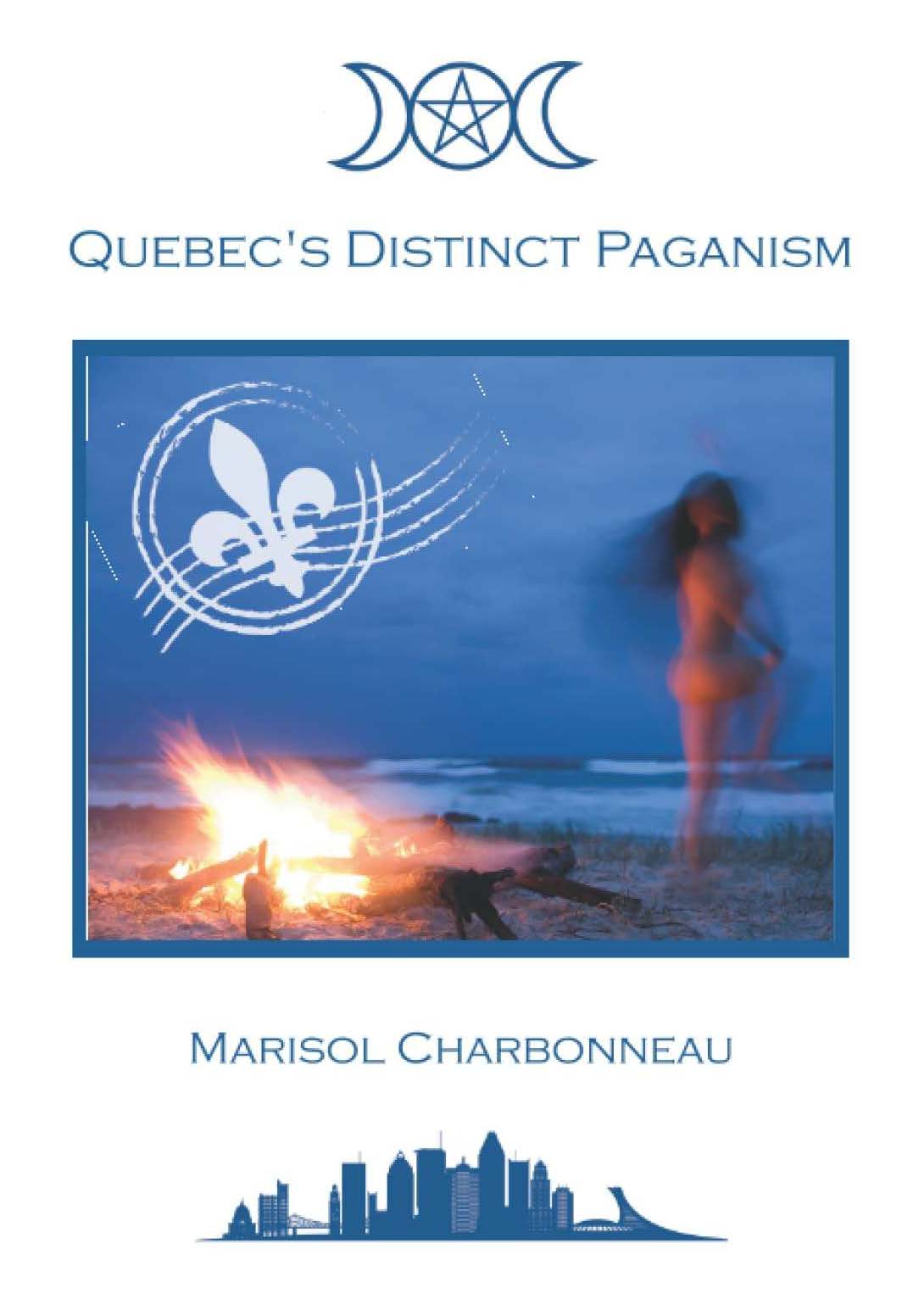
It’s always a little iffy translating a Masters’ thesis or Doctoral dissertation into something for a wider, non-academic audience. Marisol Charbonneau’s MA was awarded in 2008 and after several false starts she reworked the thesis into this book. Her research was in the city of Montreal, the largest city and the most bilingual one in Quebec and she was able to translate and include material from another Francophone scholar, Mireille Gagnon, whose doctoral research on Paganism outside Montreal paralleled hers. Quebec is a distinct society in Canada, and in North America, as a principally French-speaking area with a strong identity (and notably, self-governing in areas of language, education and culture as a Canadian province), and this is a very interesting glimpse into the distinct forms of Paganism that have developed there.
The majority of the Pagans in Montreal are Anglophones, which is unusual given that 80% of the Quebec population speak French. Many Francophone Pagans also use English as their liturgical language, in part because relatively little of the standard texts of neo-Paganism have been translated into French. Because immigrants in Canada have less pressure to assimilate, with the model of multiculturalism within a bilingual nation, there is greater access to cultures of origin and less need to ‘reclaim the culture and religion of our ancestors’ here. Specific factors in Quebecois history and culture, particularly the rapid and thorough secularization of the province in the 1960s ‘Quiet Revolution’, have had a major impact which reverberates through to Francophone Paganism.
One interesting insight, which is broadly shared with the neo-Pagan communities elsewhere, is the historical amnesia of these communities. Although Quebec has a long history of folk magic practices, there is virtual none of it in the Pagan community. As well, other alternative religious and occult traditions in Quebec such as the Thelemic groups, the immigrant Vodou community, and the Raelians, do not intersect in any meaningful way with them. Another interesting difference is the very small impact of feminist Craft and the lack of gender-exclusive groups as a result of the Quiet Revolution and the strong norm of gender equality in Quebec.
This is not an easy or casual read. From its obvious origin as an MA thesis, there are numerous tables, exhaustive details of the respondents to her surveys and interviews, a very good literature survey as well as the texts of her surveys, and the like. She discusses the role of community meeting places and organization, bookstores and some online resources, publications and literature. The quotes from interviews give insight into the lived experience of Quebecois Pagans. Rather dry, could have seriously benefitted from some editing to emphasize discussion over data. Nonetheless, this is a useful reference work.
~review by Samuel Wagar
Author: Marisol Charbonneau
Arcana Elements, 2022
266 pg. Softcover £16 / $30 Can / $22 US