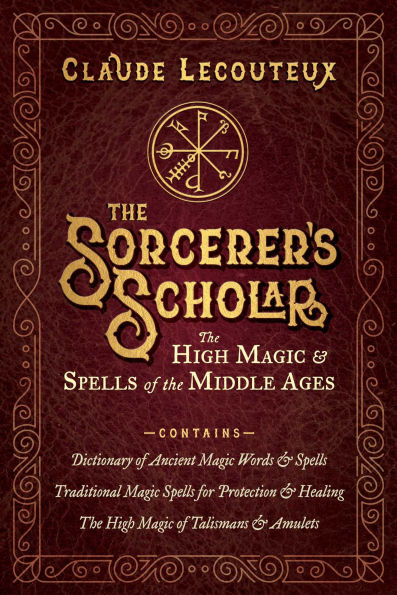
Every person seriously working in the Western Magic(k)al Tradition has at least a couple of the classic works of Renaissance magic – Cornelius Agrippa, Marsilio Ficino, and Pico della Mirandola (plus, likely Barrett and Levi and Mathers’ “Key”). We may think first of the High Magic tradition when we think of Europe in the Middle Ages and Renaissance but miss out on the principal magic users of the time, the literate clergy who did healing spells as a side gig and the cunning men and wise women of the countryside.
What is interesting, different, and valuable about Lecouteux’ work is his collection of Low Magic from Medieval sources. I believe the title of the collection is a bit misleading as his interest here is not in High Magic but folk magic, spells for curing common diseases, finding love, protection, although he briefly discusses crossovers into High Magic. He is drawing from a wide set of sources, which he acknowledges and cites in excellent bibliographies, and moves beyond the confines of Western Europe. Although this boxed set brings together three books originally published separately, they complement each other well.
The 1st volume of this collection is a helpful Dictionary of Ancient Magic Words and Spells (2014). He begins with a brief discussion of the power of words, definitions of types of spells, the blending of Christian and Pagan ideas in Medieval magic and sources of the language used in spells, and the areas where spells were typically used (healing and protection, principally, although spells of attraction and seduction are also included here). Lecouteux drew from seven thousand spells from France, Italy, Poland, Romania, Iceland, Sweden, the Middle East and elsewhere in compiling this dictionary. Many entries discuss the spell in detail, as for example the Sator square, while other entries are briefer, listing a word and its meaning and where it appears or a spell and its purpose. He also discusses magical concepts like the inscription conventions, names of God, names of demons, various grimoires, magical alphabets and sigils (both called by him ‘caracteres’ and expanded on in the volume on talismans and amulets). Numerous illustrations from charms and amulets are included.
The 2nd volume is Traditional Magic Spells for Protection and Healing (2016). A tremendous collection of 573 spells, including some collected more recently, organized alphabetically by purpose inside the chapters; Diagnoses; The Illnesses of Humans and their Cure; Evil Spells; Devils and Demons, Fantastic Beings and Spirits; Healing of Animals; Protections. Each spell has its origin cited. He rounds out the volume with several short appendices and the bibliography.
The 3rd and final volume in this collection is The High Magic of Talismans and Amulets (2005). He draws on folklore about amulets as well as medical and magical texts, largely from France and ancient sources. Well illustrated with examples of talismans and amulets. He begins with a historical general discussion of what amulets and talismans are, Medieval amulets, Christian amulets, medical amulets, summary of their uses and how to make amulets and talismans and to purify and consecrate them. This is largely a discussion of secondary sources, although he is very well-versed in the grimoires, and he discusses the origins of each working. This volume is a very valuable general guide to this area of work.
I will make a note on the translation – considering that Lecouteux writes in French and translated many of his sources from German, Latin and Greek, the language of these books is clean and effective English, if a little formal. The books are well-designed, well-illustrated, and very good reference texts, bridging High Magic ideas and folk magic, filling in a gap in my magical reference library.
~review by Samuel Wagar
Author: Claude Lecouteux
Inner Traditions, 2025
1010 pg. Hardbound (three volumes) £71 / $120 Can / $95 US