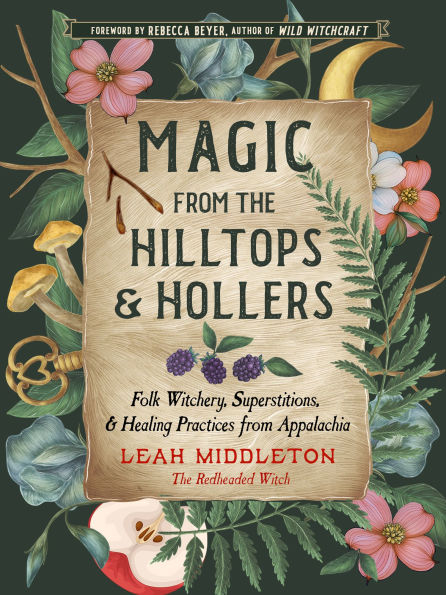
This book is a love letter to Appalachia, from a nostalgic ex-patriot remembering the area, as much as it is a manual on folk magic. Middleton’s style of writing is soft and a bit over-flowery. She mixes in personal experiences and anecdotes freely along with the details of magic and history, which gives the book a friendly and conversational tone. She is not systematic in her approach, relying on an impressionistic style to evoke, she hopes, a sense of the place and the magic done there.
The first couple of chapters set the stage with a very personal introduction followed by ‘Welcome Home’ which outlines the geography and the cultural mixture of indigenous people and waves of settlers, including enslaved people, and the complex legacy of religion and the Civil War on the culture of the region. She continues with ‘On Front Porches and in Garden Beds’ sketching some foundation ideas of Appalachian culture – homesteading and self-sufficiency, foodways, music, folk arts, and religion including folk saints. And she includes a few recipes here.
‘By the Devil’s Hand – Witchery’ presents local tales of witches and ideas of the devil-as-trickster, and the initiation to witchcraft. The next chapter ‘Help or to Harm – Folk Magic Practitioners’ is where she moves from broader generalizations to specifics – describing several types of folk magic and practitioners, listing mundane items used for magic and their properties and providing some spells. Then ‘The Mountain’s Helping Hands; Folk Healing,’ another more detailed chapter on herbalism using a list of plants both native and invasive, blending traditions, talking about both books and oral knowledge, diagnostics through divination, dreams, and the mix of physical and spiritual healing.
Although she has been telling stories throughout to illustrate her points, the chapter ‘A Tale Worth Telling; Superstitions, Spirits and Omens’ centres on the importance of story-telling in folk magic learning and teaching including stories of her own experiences as well as some ghost stories and folk tales, lore of the little people, various superstitions connected with life and death and protection magic, and with hearth and home.
Her concluding chapter, ‘The Finished Binding’ begins by discussing recovered ancestral knowledge and stories and moving from these roots to changing and creating new traditions. Because folk traditions change as the folk do, as the world does. She continues the book’s valuable emphasis on multiple sources and multiple paths drawing from the accumulated pool of ideas and knowledge. She broadens her discussion of community care, healing in context, and community embracing nature to include practical real-word concerns such as improving access to housing. She emphasizes again honouring the elders and the ancestors.
This book was written as an introduction to folk magic and Appalachia, but I would have liked to see her to dig into some of the issues that interlock with the folk traditions that she is writing about in more depth. To her credit she does talk about the miners’ resistance and class politics, evangelical Christianity and the present-day reactionary politics of the region. There are great strengths that I will point to – her celebration of the synthesis of peoples and ideas from many places coming together in this folk magic and culture, the friendly and personal tone, her insider’s perspective.
Worth reading, absolutely! But a start, a taste, not a meal.
~ review by Samuel Wagar
Author: Leah Middleton
Red Wheel/Weiser, 2025
221 pg. Paperback £14 / $27 Can / $19 US