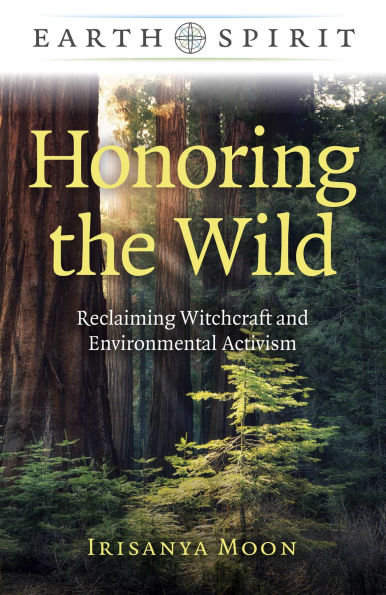
Honoring the Wild: Reclaiming Witchcraft and Environmental Activism now marks the seventh book in the Earth Spirit series and the sixth book by Irisanya Moon that I have reviewed (not all here at Facing North). I’m not sure if there is any magical or numerological significance to this fact, but certainly I come to this review with a fairly informed sense of what the book series itself and the author might be attempting to convey as part of a larger program.
The Earth Spirit series aims to promote an Earth-based awareness and an eco-spirituality, by which is meant a recognition of the reality of the climate crisis and ecological degradation as the result at least in large part by human activity and especially the larger political and economic forces that contribute to the imbalance and destabilization of the ecosphere. An Earth-based awareness means also, of course, a conscious realization that humans are not separate from but are deeply interwoven with the fabric of ecology and exist as inseparably interdependent with the vitality of the natural world. By “eco-spirituality” one can include a number of spiritual and religious practices, ideologies, and philosophies that emphasize the values expressed above and that stress the need for active, phenomenological engagement with the living ecology in all of its grandeur and biodiversity. The common linkage within the diversity of eco-spiritual practices is a recognition of the sacred within nature rather than beyond it, that nature is itself sacred. Practices within the rubric of eco-spirituality include shamanism, animism, mystical sects of all the monotheistic as well as polytheistic faiths, and as in the case of this book by Irisanya Moon, the Reclaiming witchcraft tradition with its roots in the Goddess movement, eco-feminism, and environmental activism. Reclaiming as a tradition and practice “arises,” Moon explains in a previous book, “from a deep, spiritual commitment to the earth, to healing and to the linking of magic with political action” (Reclaiming Witchcraft, p. 11). Reclaiming “honors the wild, and calls for service to the earth and community” (Honoring the Wild, p. 4).
Let me say at once that I enjoyed this book. It is short, very readable, and a great stimulant to thought. It is a compilation of stories and vignettes on ecology and environmental activism from eighteen contributors, some of whom have been involved in the reclaiming movement since the 1970s and some of whom have only recently become engaged with activism in the past decade or so. One of the contributions is a poem inspired by the sense that whatever else the sickness may be, “wilderness is the treatment” (44). The first contributor to the book writes of the “very deep witnessing” that is central to her magical activism, acknowledging the practical importance of an engaged activism in the form of active social protest and such, but notes that “the environmental activism that has had the biggest impact on my life has been a silent connection with our living planet” (13). Another contributor sees that “green is as much an attitude as a prescriptive set of actions, and at its best it stems not from guilt but from love” (22). Indeed, it is this kind of an attitude or ethical investment that serves as the bedrock for any kind of environmental activism; to hold such a view is itself environmental activism, be the actions that follow from such an ethic grand or small in scale, public or private in expression. The point is, as several contributors make in this book, to begin with a sense that one’s own connection to the earth matters and the ways in which one engages from the place that one is—this, and this alone, makes any activism possible.
Being such a short book, still it resonates with ethical impact and philosophical force, as in one passage that describes “animism” in a way that personally I find rather useful. In the section on Ritual & Magick, one contributor in discussing ways of making a meaningful offering as a way of magical practice notes:
It is possible, but not necessary, to integrate a kind of animism into this process. The conceptual and political advantage of animism in this and similar situations is to emphasize the uniqueness and integrity of a part of an ecosystem, be it a stream or a tree or a mountain. Animism need not be true, but it points to a truth: The concrete, non-human beings that make up our world are owed care and respect. (34)
This is an interesting conceptual turn, and an interesting way to reframe the issue of animism. Yet the basic issue remains that for those who do not recognize inherent value in “non-human” nature, who would expressly deny any validity to the concept of animism, if animism “need not be true” then why indeed is that non-human world of nature “owed care and respect”? It’s not an easy problem to solve—yet it is helpful to see terms of debate reframed in potentially useful and illuminating ways.
At the end of the day, Honoring the Wild serves as a productive stimulant to thought and as an effective primer for understanding the role of the Reclaiming tradition in environmental activism from the point of view of at least some of those who have “been there,” and who still work to effect the kind of change that is needed to counteract the great harm done to the environment by those who simply don’t see it as a problem—or as big of a problem as it is. “How do I practice activism?” a later contributor in the book asks. The simple yet ethically grounded answer: “In the ways that I can” (51).
What it means to honor the wild might best be read in a poignant passage from the book’s final contributor: “I am learning to listen to land—to read the seasons, hear its history, ancient and colonised. Open myself to communication with the original people of this place. To stand in a connected space and not to be overwhelmed by destruction, by the chaos. To look the mess that humanity has created directly in the eye” (59).
And from that place of deeply embodied, phenomenological investment in and acceptance of the full scale of the reality of the ecological situation is all environmental activism born. Aldo Leopold described this rooted sense of ecological awareness and investment as a “land ethic” born of a “conservation esthetic.” The language differs somewhat but the argument is the same: Nature matters and is a force and reality of ethical concern. Thoreau wrote that “In Wildness is the preservation of the world.” So indeed the Reclaiming witchcraft movement does not hold any first claim to the kinds of ideas and ethical practices discussed in this book. But it does carry into the twenty-first century one of many needed movements and frameworks for promoting the ecological conscience and environmental awareness that is needed if humanity is to survive and thrive in any sense that matters beyond brute exploitation. This savage view of humanity’s place in nature is not only an outdated ideology; it will come to be viewed, if humanity breaks through its ecological ignorance and ethical adolescence, as an unfortunately prolonged chapter of history relived all too many times before the “rogue primate,” to use another philosopher’s term, finally woke up and joined the rest of the rational, natural world. Books like this one can help until then.
~review by Christopher Greiner
Author: Irisanya Moon
Moon Books, 2023
pp. 88, $10.95
Chris